


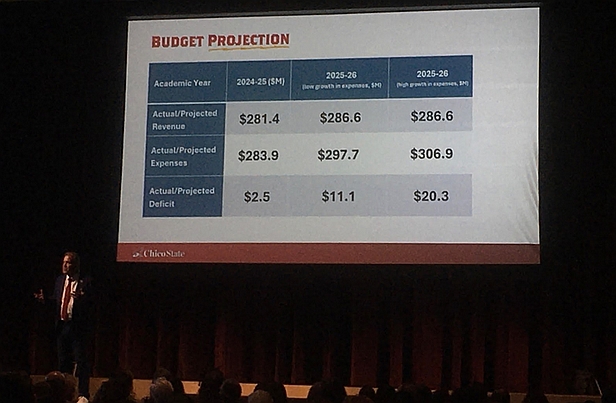
Chico State carried forward a $2.5 million deficit, which it paid for with its reserves, rather than the initially projected $8 million in the 2024-25 academic year. The university did this through tuition increases, cost savings and advocacy for a return in state funding that was cut.
Budget has been top of mind for the university as enrollment had been declining following the COVID-19 pandemic, Camp Fire and overall changes in college culture. In the 2017-18 academic year, head count and full-time-equivalent students reached a high point at around 17,500 and 16,000, respectively.
Since then, enrollment had trended down, reaching its lowest point in the 2022-23 academic year. Now, for the past two academic years, headcount and FTES have trended upward, with last year seeing a headcount of around 15,500 and FTES of around 13,500.
Both headcount and FTES are expected to continue to rise into this academic year, said President Steve Perez during his welcome speech.
This academic year, the projected worst-case scenario deficit is $20.7 million, Perez said.
FTES, or full-time-equivalent students, is what the Chancellor’s Office and the state look at to give funding to Chico State. While headcount is important for the local community — and especially for Dining Services — when it comes to budget, the numbers that the university tends to focus on are FTES.
As of June 30, the university has $184 million in general reserves, but only $46 million is unrestricted, according to Ashley Gebb, Interim Chief of Staff. The restricted reserves can’t be spent on salaries or operational expenses.
The restricted reserves originate from various funding streams. For example, the state gives money to the university to build new infrastructure, that money can solely be used for that purpose.
Furthermore, student fees, like the student union fee, will only be spent on things within the student union, said Stacie Corona, Associate Vice President of Financial Services.
Breakdown of Cost Savings and Additional Revenue
The university saved $2.5 million in salaries and benefits from vacancies, which are staff or faculty positions left unfilled, either temporary or ongoing.
The 2024-25 budget anticipated spending $212.5 million on salaries and benefits. Due to delaying filling vacant positions or intending to leave those positions unfilled, the university only spent $210 million, Corona said.
This means the university’s largest planned expenditure also became its largest category of saving.
The $2.5 million in salary and benefit savings can be broken down into:
- $1.5 million from benefits (majority from retirement)
- $700,000 from staff
- $250,000 from management
- $0 from faculty
The next largest category of savings, $1.9 million for the university, came from utilities. Corona credited milder weather, more energy-efficient infrastructure and new buildings that were not fully occupied the entire year, such as the University Services Building and the Behavioral and Social Science Building.
The university budgeted for those buildings to be utilized for the entire academic year, according to Corona. So, with those buildings only being used for part of the year, it saved a lot from the projected expenditures.
Now, those buildings are running at full capacity, which means these savings were a one-time advantage.
There was also $1.5 million from technology savings, partially due to the implementation of a campus-wide level refreshment of computers, called the “computer refresh” program.
Previously, each department would manage purchasing new computers. However, now that’s being done at a campus-wide level, expediting the task and allowing the university to buy computers in bulk.
The refresh program is still in the process of being fully implemented.
Some departments have moved over to this plan, while others are waiting. University officials are hoping to move every department over to the campus-wide system by the end of the academic year, Corona said.
Operational expenditures also fell short of the expected cost, with savings of just over $1 million. This category contains miscellaneous items such as “ … equipment, travel, contractual services and other various smaller costs,” Corona said.
The university also budgeted for small, pre-planned maintenance projects that were never done, resulting in savings of $500,000.
The Chancellor’s Office gives an approximate amount for each of the 23 California State University system campuses to budget for the CSU system-wide insurance called the California State University Risk Management Authority.
Chico State’s premiums were $275,000 less than the anticipated amount, meaning that there may have been fewer claims and losses than initially anticipated.
It wasn’t just spending less than the anticipated budget that led to the university falling short of its projected deficit. With a tuition increase and increased enrollment, the university was able to make $4.5 million more in revenue, which offset many of the costs that the university had.
On Sept. 14, 2023, the Chico State Board of Trustees approved a 6% increase in tuition over 5 years to help deal with the budget crisis that the university is currently facing.
The university also spent more than projected in work study, overshooting their projected amount by about $1 million for student assistants and teaching and graduate assistants.
What to Expect this Year
The university handles the budget from a very top-level perspective, Corona explained.
The university sets each division’s budget and allows the individual divisions to decide how to spend the money allotted. Last year, each division received a 5% reduction.
It was expected that each division would face another reduction coming into the 2025-26 academic year; however due to the university regaining $7 million of the initial $12 million cut from the state budget, the university is expecting to keep the budget for each division flat with minor adjustments, according to an email from the Office of the President.
Those adjustments will come from removing management and benefit costs from the individual division to the campus level. Also, there will be “… internal reallocations of programs or employees between divisions,” according to the same email.
Enrollment is still lower than in the past, but it continues to trend upward. Currently, the projected headcount for the Fall 2025 semester is 14,885, a 2% increase from Fall 2024. Similarly, FTES is trending upward too, with an expected 2.4% increase, President Steve Perez said during his welcome speech.
In good news, Corona said that FTES might be higher than expected. The official enrollment numbers will be available later in September, according to Director of University Communications Andrew Staples.
While the university spent less than expected from last year, many of those savings were one-time savings. The vacancies at the university that were delayed will likely be filled.
The university’s goal is to use less than $10 million in reserves for the 2025-26 academic year, according to Gebb. However, the university has budgeted, based on various scenarios, between $11.5 million to $20.7 million, according to the email sent out by the Office of the President.
“While we are fortunate to have reserves, we have spent from them the last two years and simply cannot draw too much from them to cover overages in spending,” the email stated.
The finalized 2025-2026 budget is expected to be released within two weeks, Corona said.
Chris Hutton can be reached at [email protected] or [email protected].
