


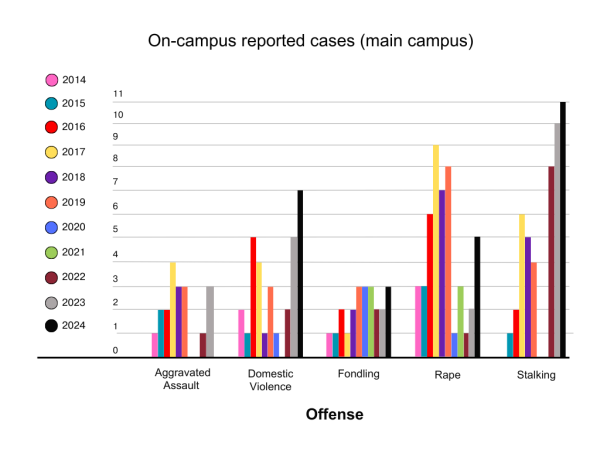
Reported cases of domestic violence, rape and stalking increased at Chico State in the 2022-24 time period, according to the 2025 Annual Security Report released by Chico State’s Office of the Clery Director on Monday.
Statistics for the past three years are compiled from direct reports to the University Police Department, allied law enforcement agencies and Campus Security Authorities, who are individuals required by their position at Chico State to take action when crimes are reported to them.
The figures include Clery-reportable crimes that occurred on campus, in certain off-campus locations, property owned or controlled by the university, and on public property within or immediately accessible from the campus. The ASR includes reports of all alleged criminal incidents, not only crimes where a finding of guilt is made.
The ASR is one of various sources of information on campus safety, noted Erin Tarabini, the Clery Director and Compliance Investigator.
“It provides transparency about trends, campus safety policies, reporting options, and prevention efforts, but it is not meant to capture every detail of campus safety in real time,” Tarabini said. “Looking at the report in context — alongside other resources, programs, and communications — gives a fuller understanding of safety on campus.”
There are five categories of crime that must be published, including criminal offenses, hate crimes, hazing, Violence Against Women Act offenses and arrests and referrals for disciplinary action.
In the three-year time period of this report, one hate crime was reported in 2022. There were no cases of Clery-reportable crimes for the University Farm location, though there was one unfounded crime for that location in 2022.
A notable set of numbers concerned weapons law arrests, of which there was one in 2022, nine in 2023 and one in 2024. The weapons law arrests can vary from year to year and are not limited to firearms, explained Tarabini.
“In some cases, the arrest may occur as a result of contact during another type of incident — like a drug or alcohol arrest — rather than a weapon being brandished,” Tarabini said. “The increase in 2023 was likely the anomaly in the last three years.”
Tarabini emphasized the new inclusion of the CSU Hazing policy and procedures in the ASR, in accordance with the Stop Campus Hazing Act and Clery Act updates from late 2024.
Following the amendment, institutes of higher education must disclose statistics on hazing incidents, publish information on hazing prevention programs and develop a Campus Hazing Transparency Report.
The CSU Student Code of Conduct defines hazing in-depth and states that the consent of a hazing victim or the lack of active participation in a hazing incident is not a defense.
Additionally, passive participation, endorsement, approval or validation of hazing all violate the code of conduct. A reporting method specifically for hazing can be found at the university’s hazing report form.
Blue Light Phone testing and active shooter training are among the security awareness and crime prevention programs highlighted in the ASR. In an annual Moonlight Safety Walk, members of the Public Safety Advisory Board and the president identify physical safety concerns on campus, including inadequate lighting or overgrown bush.
In addition to the ASR, universities must also release an Annual Fire Safety Report, in accordance with the Higher Education Opportunity Act. Each year from 2022-24, a fire was reported in University Village — a grease fire in a resident kitchen, a fire in the microwave of a resident kitchen and a fire in a water heater closet, respectively. The grease fire, reported in February 2022, resulted in about $75,000 worth of property damage.
Both Title IX and the Clery Act both play a role in higher education in regard to transparency of information that concerns students and others on campus. Under Title IX, sexual harassment and sexual violence are reported, and under the Clery Act, criminal offenses, hate crimes and incidents of dating violence, domestic violence and stalking are reported, according to a document outlining the intersection of Title IX and the Clery Act created by the White House Task Force to Protect Students from Sexual Assault.
In opening remarks for the ASR, Chico State President Steve Perez noted that the responsibility of reporting concerns and engaging in prevention efforts is a collective one.
“We recognize that a strong sense of safety and belonging does not emerge from policy alone,” Perez said. “It is nurtured through daily action, mutual respect, and a culture where people look out for one another.”
To make reporting easier and more accessible in recent years, Tarabini said Chico State created the “Report a Concerning Incident” centralized webpage and expanded training opportunities for community members to learn when and how to make reports.
Copies of previous year’s reports are not available online once the current year’s report is published, according to Tarabini, but requests for those copies can be made and are provided in accordance with CSU record retention standards. ASRs must be published by Oct. 1 each year.
Individuals can make voluntary, confidential reports to Tip411 and find information about reporting crimes at University Police’s report line.
Raquel Frohlich can be reached at [email protected].
