


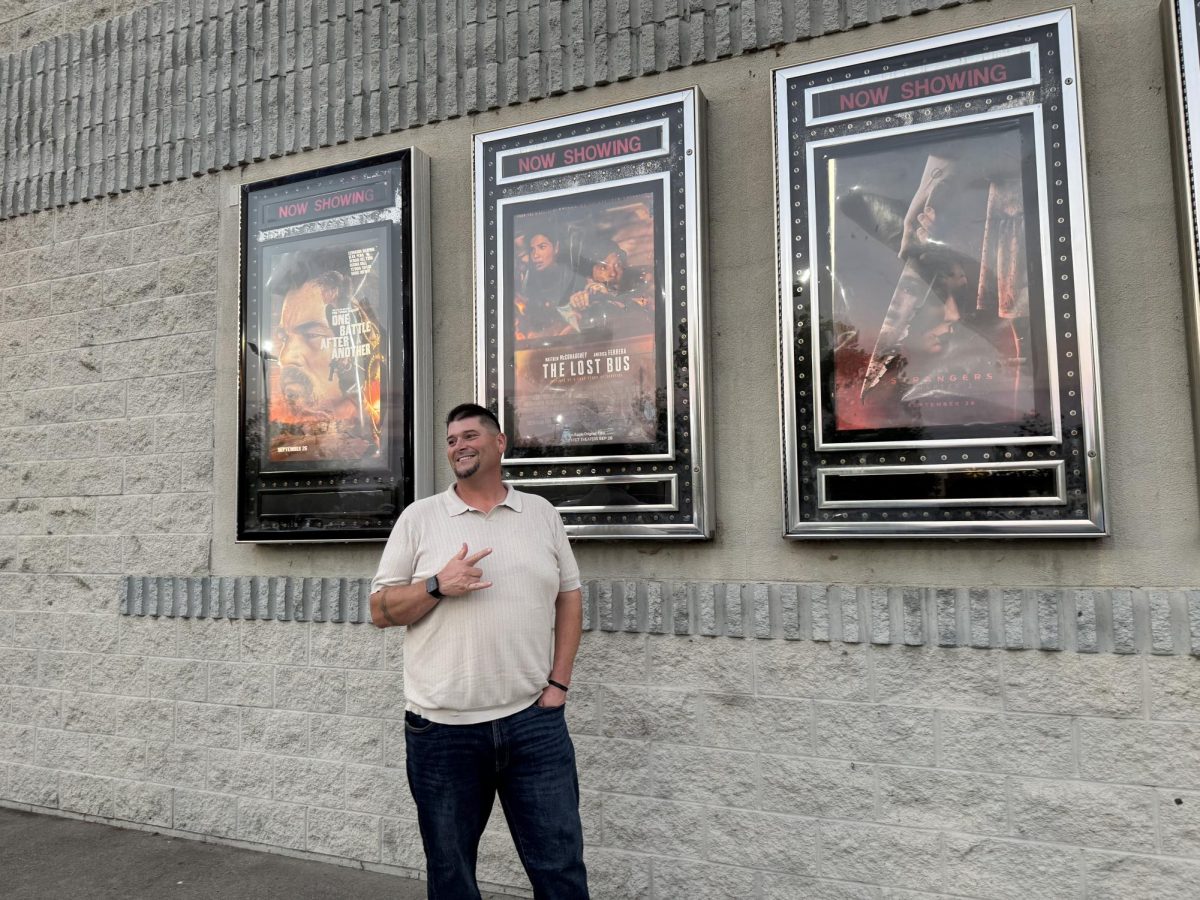
As the seven-year anniversary of the Camp Fire approaches, the courageous story of a bus driver — Kevin McKay — driving through grid-locked traffic, inflamed roads and suffocating smoke to bring a group of 22 schoolchildren to safety, is told through the big screens, speaking to the communities most affected by the nightmarish fire.
Community members, many of whom are survivors of the Camp Fire, arrived at Feather River Cinemas in Oroville on Thursday to watch the “The Lost Bus,” directed by Paul Greengrass.
The Camp Fire was the deadliest and most destructive wildfire in California history, with 85 people being killed and over 18,000 structures burned down. The fire began in the early morning of Nov. 8, 2018 after an aged PG&E electrical transmission line broke in the Feather River Canyon due to extreme winds, exceeding speeds of 50 mph. In a matter of hours, the fire enveloped almost all of the approximately 26,000-person town of Paradise, forcing a mandatory evacuation of the entire town.
The film stars Mathew McConaughey, who plays the bus driver Kevin McKay. McKay had seen the film previously, but came to the showing at the Feather River Cinema with friends.
“I think it’s really important that we all take a self-inventory and figure out how we’re going to respond to a super tough situation,” McKay said. “I’m gonna be someone who helps others.”
As the town of Paradise received the evacuation order, a group of 22 schoolchildren had no present family to pick them up. McKay responded to the call from the dispatcher to bring the children from Ponderosa Elementary School to the alternative safety point, where they would be picked up by their families.
McKay and an elementary school teacher, Mary Ludwig, fought to bring the children to safety, despite being trapped by a fire that had consumed much of the town, and with no way to communicate with anyone except those confined within the rapidly overheating school bus.
The film detailed the events of the Camp Fire from the perspective of McKay, CALFire and the schoolchildren, but everyone had a story on that harrowing day. Chuck Forquer shared the times he fought through similar situations when attempting to evacuate with his mother, Carol Foley.
Forquer recalled the fire overrunning their vehicle and their inability to see anything through the dense smoke. The rapidly advancing fire cut off their escape route. As the fire closed in, they feared that their gas tank would explode — so, they shut off their vehicle with fire raging around them.
Foley and Forquer made it out with their lives, but for Foley, her third-degree burns leave an imprint of that day.
On the outskirts of the Camp Fire, Butte Valley-resident Mark Gustafson recalled using a four-gallon backpack sprayer to fight the spot fires that rushed his home throughout the night.
On the day of the fire, Gustafson saw the smoke from Paradise. On his way home from the school he worked at in Chico, he reached a dead-end. The police had blocked off the exit that led to his house. He swung around Oroville, taking an extra hour to reach his home. He watched as the fire advance over the hill. They filled their car with emergency supplies and two dogs, then drove down their driveway.
The embers from the fire triggered spot fires around the property. After feeling confident that it was safe to return, they drove back up their driveway. “Our house was pretty much on an island,” Gustafson said. “I knew I had to put out fires that were creeping up toward the house.”
While Gustafson was able to save his house, some of his neighbors’ houses burned down. Earlier that day, CALFire made the decision to focus solely on rescuing lives. So, when Gustafson’s wife, Jennifer, called to have an engine extinguish the neighbor’s house that was engulfed in flames, CALFire told her that there was nothing that they could do, their only priority was to save lives, not property.
This was detailed in the film after Battalion Chief Raymond Martinez — played by Yul Vazquez — made the decision that there was nothing they could do to stop the rapidly growing fire, deciding it was time to use every resource available to save lives.
“There was a lot the firefighters couldn’t do; it was so massive,” Gustafson said.
Wildfires aren’t uncommon in Northern California, with thousands occurring each year. For Berry Creek resident Grant Nethery, the film brought back memories of the North Complex Fire, which destroyed the town where he currently resides.
“It hits really close to home,” Nethery said. “Fire is a real threat, and if we don’t circumnavigate each summer accordingly, things like this will happen again.”
For many who attended the screening, the film brought vivid memories of that day to the surface. This is why theater owner Jeremy Smith worked with the Red Cross and dozens of other organizations to offer support to those who may need it.
As attendees walked down the dimly lit hallway toward the theater, self-care posters covered the walls. At the end, a Red Cross booth awaited with stress balls and various resources.
“I think it’s really important that we all take a self-inventory and figure out how we’re going to respond to a super tough situation,” McKay said. “I’m gonna be someone who helps others.”
When the school bus emerged from the all-consuming smoke and the daylight struck the partially scorched bus, the audience erupted into cheers, with some hardly able to believe the events that transpired as disputes about the scenes broke out between some attendees and people who experienced the Camp Fire.
The film displays PG&E’s negligence that led to the Camp Fire. PG&E was charged with 85 felony counts and, ultimately, pleaded guilty. PG&E reached a $522 million settlement deal with $270 million for Paradise and $252 million for Butte County. PG&E also reached a settlement for $13.1 billion for victims of the Camp Fire.
The film closes with McKay driving back to his now-lost home, only to see that the community he grew up and lived in had been reduced to ash. The Camp Fire displaced about 50,000 people, many of whom, as Foley put it, moved on to somewhere else.
For Foley, this is noticeable in her church, where just 6 families remain in Paradise from that day; the rest, she remains in contact with through phone.
“The Lost Bus” will be available Friday on Apple TV+ with select showtimes at The Pageant, Feather River Cinema and other theaters in towns around Paradise.
”What I want people to take away from watching this film is just how important it is that our humanity comes out and that we sacrifice for others.” McKay said.
This story was produced in collaboration with North State Public Radio. Ken Devol contributed reporting.
Chris Hutton can be reached at [email protected] or [email protected].
