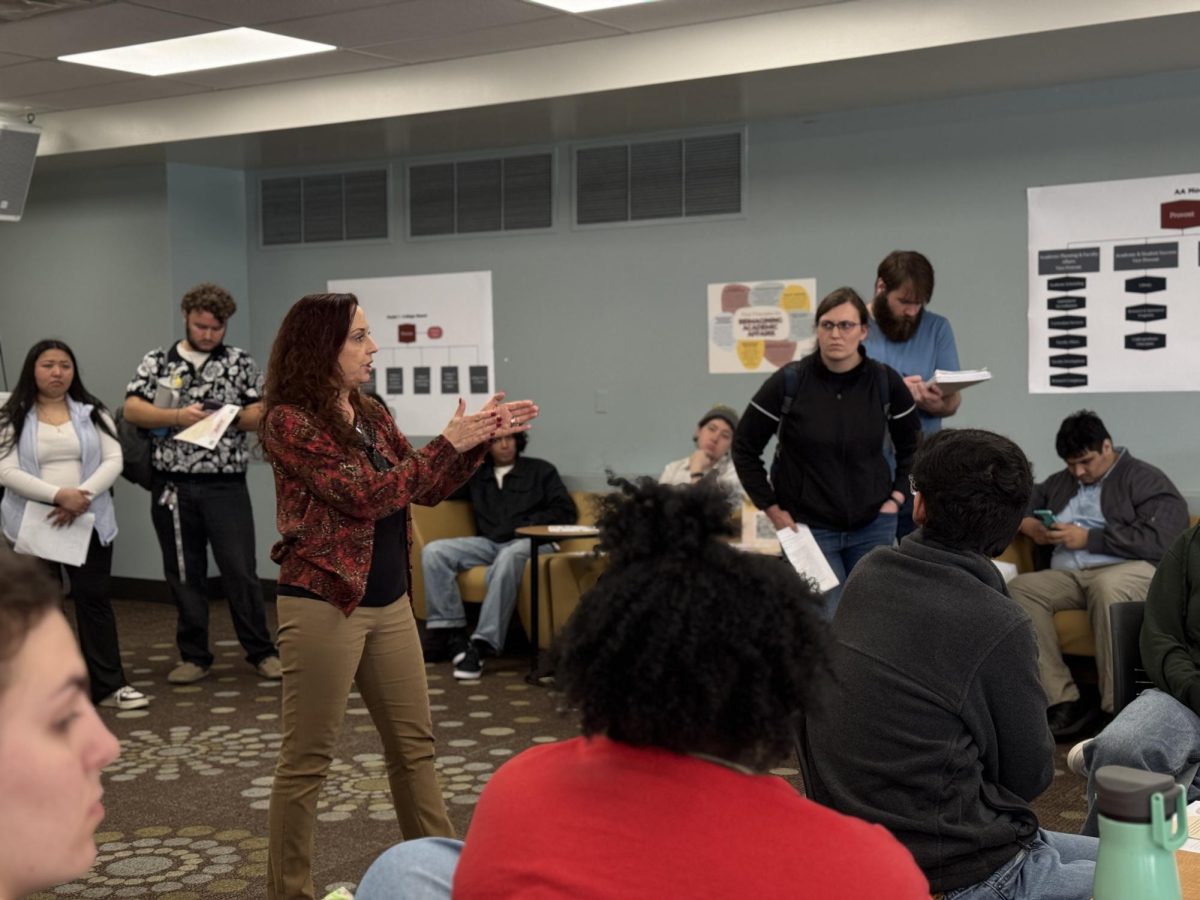
After a semester of attempting to restructure the university’s 7-college model — often to pushback and frustrations from the campus community — the reimagining initiative led by Provost Leslie Cornick will not continue, at least not in the same way.
“I don’t have any specific plans right now, or a specific timeline, to do any of the restructuring that was part of the reimagining,” Cornick said. She later said that conversations are underway among faculty about department consolidation, but that nothing is coming from the Provost’s Office.
Cornick explained that feedback from the campus community made it clear that people didn’t want a “big, comprehensive restructuring.”
At the end of last semester, Cornick nearly faced a vote of no confidence in the Academic Senate for a variety of reasons — the reimagining being among them.
“I heard from people that this is not the direction they were ready to go in,” Cornick said about the Academic Senate meeting. “We exist in a shared governance model. As a person, I tend to be very self-reflective, and I’m not interested in pushing forward something that people don’t feel comfortable with or aren’t ready for.”
So, taking a step back, Cornick is letting faculty lead the way for new ideas.
“We won’t be putting in any proposals for major restructuring that are coming out of the provost office; we’re just having those smaller group conversations and seeing what incremental changes those groups are interested in pursuing,” Cornick said.
Cornick is speaking with the Department Chairs Council, gathering ideas from faculty on ways to make department structures more efficient, a core tenet of the reimagining.
When asked what Cornick would say to students who may be frustrated that they are not being kept in the loop while the reimagining is continuing in a different way, she pushed back.
“Well, it’s not really a comprehensive restructuring that’s coming out of my office,” she said. “Individual groups of community members are having their own changes that make sense at their level.”
While ideas from the reimagining are moving forward in their own ways, some in the campus community still struggle with what they see as a continuing lack of communication and transparency from last semester to this semester.
In response, Cornick provided examples of putting out surveys, holding expos, town halls and making adjustments to accommodate requests, such as students asking for student-only expos.
“It’s hard for me to translate that into a lack of transparency and a lack of community involvement,” Cornick said.
But issues with transparency and community involvement didn’t start with town halls and expos.
The reimagining began in August 2024 with Cornick charging a 19-member special action team composed of faculty and staff to present recommendations for restructuring the academic affairs model and the 7-college model.
The SAT’s December deadline to submit these recommendations was a point of contention for some members, stating there was insufficient time — something Cornick now acknowledges.
“I think the one thing that I would have done differently is when the special action team didn’t get quite as far as what I had asked them to do in their charge letter,” Cornick said. “I would’ve given them another semester before we started moving into the next part of the process.
Despite all of this, Cornick still considers the reimagining to be moving forward.
“If the fundamental question is: are we continuing with the reimagine? My answer is sort of yes. It’s just continuing in a different form,” she said.
That different form is the result of faculty and staff collaborating with the help of the Provost’s Office.
“People reimagine things in different ways at different scales all the time,” Cornick said. “We tried to do something big, and it was too big. And so now we’re letting people in the community reimagine things in their own way, and not have it feel like it’s coming from me, that it’s coming from the community.”
Chris Hutton can be reached at [email protected] or [email protected].