


The multimillion-dollar initiative to create an AI-empowered higher education system comes at a time when the California State University system (CSU) is experiencing budget issues.
In 2024-25, CSU’s budget was about $8.5 billion, and for 2025-26, an additional $593 million was requested, bringing the total to about $9.2 billion. CSU campuses have faced “significant cost pressures due to unfunded mandates, rising operational expenses and underfunded compensation increases from 2023-24 and 2024-25,” according to an executive summary.
With a looming $397 million budget cut as of September 2024, the artificial intelligence initiative continued to be an essential budget priority for CSU. The cuts were then decreased to $144 million for 2025-26 — with the final budget deferring the $144 million to the next fiscal year — though the CSU system faces an estimated $2.3 billion budget gap that has “worsened significantly.”
In a 2025-26 Operating Budget Request, it was stated that the CSU had no dedicated funding for AI but was “able to divert less than $200,000 in 2023-24 and 2024-25 to support faculty development efforts, GenAI technology platform testing and GenAI software licensing.”
According to the request — in which the CSU sought $7 million — there would be implications for not receiving additional funding to integrate AI into the CSU system, such as “a widening gap in AI literacy among our students, a loss of knowledge production and falling behind in expertise.”
Systemwide budget burdens have fallen onto the shoulders of students, too. Two years ago, the CSU Board of Trustees approved a multi-year tuition raise proposal, at 6% each year.
Though the CSU’s contract with OpenAI expires in June 2026, AI is not going away, and CSU plans to continue providing students with AI tools and services, according to Amy Bentley-Smith, director of Media Relations and Public Affairs at the Chancellor’s Office.
CSU’s deep-dive into incorporating AI use in higher education dates back to 2019, and a rationale note in a May 2019 resolution stated, “Because AI particularly facilitates the automation of cognitive tasks, rather than manual tasks that prior waves of innovation have automated, the jobs most affected will be knowledge-related. Arguably, precisely those in the kinds of careers towards which we have been guiding people for the last 30 years.”
The resolution by the Academic Senate of the CSU (ASCSU) was based off a white paper on “Artificial Intelligence: And Its Impact on Career Preparation, Reorientation and Lifelong Learning,” and the ASCSU requested that a working group be established by the Chancellor’s Office to propose actionable recommendations for the challenges identified in the white paper.
In 2023, a CSU Systemwide Generative AI Advisory Committee was established to “advise the system on operationalizing guidelines and policy recommendations for generative AI.” In the summer of 2024, recommendations and guiding principles presented by the committee were published.
One of the recommendations was to ensure all students, faculty and staff have access to generative AI, noted Bentley-Smith. Other recommendations include forming multi-campus collaboratives to explore AI tools and conduct pilot projects and to consider developing a curriculum for GenAI-focused majors or certificates.
In May 2025, the ASCSU approved a resolution urging the Chancellor’s Office and CSU faculty to, “when deciding on the appropriate use of generative artificial intelligence (GenAI), to consider not only its strengths and advantages, but also the issues its use creates, especially with regard to students developing writing and critical thinking skills of their own as well as mental health and emotional intelligence.”
Adobe, another company participating in the AI technology initiative, provides various services to the CSU system, including an AI Assistant for Acrobat. This AI assistant can be used as an analyst or instructor for documents and transcripts.
This product costs $24 per unit, according to an August 2025 sales order. The three-year license term lists 64,259 users per year for this service, resulting in a total of $1,542,216.
The Adobe sales order terms specify that, “Adobe will not use Customer Data to train any generative AI models,” though there are exceptions for the express written consent of the Trustees of the California State University or for being in connection with AI training done to provide products and services to and for the sole benefit of the customer.
The Chancellor’s Office paid at least $765,969 to IBM — another company mentioned in the initiative — in 2025, according to a public database listing purchase orders over $50,000 throughout the CSU system. It’s unknown if the contract encompassed AI tools, trainings or services.
Faculty advocate for transparency
The CFA has been advocating for more transparency and accountability surrounding AI, said Elaine Bernal. Bernal is the CFA associate vice president of lecturers, south, and a lecturer at Long Beach State.
“The rationale is that with the AI initiative, it certainly has a potential to heavily impact our workload as faculty, which is why there should have been the meet and confer with CFA,” Bernal said.
Most faculty are not averse to technology, Bernal noted, but for significant decisions such as the AI initiative, they said it’s important to have shared governance. Bernal has incorporated AI tools into the classroom to help non-science majors facilitate connections with chemistry, such as with an assignment called Heroes of the Periodic Table, in which students can choose to use AI to portray an element as a hero or other character.
“Whether it’s the Chancellor’s Office or the classroom, the biggest thing that all of us need to do together, collaboratively, is decide how we’re going to use AI in the classroom, and then to be clear about that,” Bernal said. CFA has a bargaining team represented by faculty from all campuses that meets about twice a month, according to Bernal, and bargaining updates are shared on a dedicated website.
“I think the best thing that I can say as far as how we want to work with faculty around AI and the bargaining and the contract bargaining is to really hear from folks,” Bernal said. “Part of the work of the bargaining team is to really represent all 29,000 faculty in the CSU.”
One goal is to leverage faculty ideas to make the strongest contract, Bernal explained, given the concerns and questions faculty have about how AI may impact workload and the nature of teaching.
“It’s really important that, when it comes to AI, to really focus on the workload component of the contract bargaining in such a way that it gives faculty the voice and the agency to do what they want in the classroom,” Bernal said. “I can do something different, another faculty person can do something different, so there isn’t really necessarily a general way of specifically using AI for faculty in the classroom that folks want to see necessarily, but it’s more about having a say of how they can use AI along with their students.”
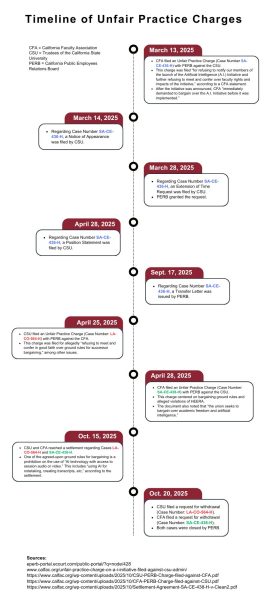
On Feb. 5, the CFA Director of Representation and Bargaining sent a letter to the Associate Vice Chancellor of Collective Bargaining & Labor Relations and the Senior Director of Collective Bargaining, requesting to “engage in the required bargaining” prior to the AI initiative being implemented, as the CFA had only become aware of it through a press release.
“This change was not announced to CFA, and it appears to be near the implementation stages without regard to the collective bargaining agreement or our rights under HEERA [Higher Education Employer-Employee Relations Act],” wrote Kathy Sheffield, the CFA Director of Representation and Bargaining. “Please cease implementation and planning until we have had time to meet and confer over this program. It appears that you seek to change the terms and conditions of employment in areas of workload, work assignments, and potential job loss.”
In Chapter 10.3 of the 2024 California Government Code that is referenced in the Higher Education Employer-Employee Relations Act, it is stated, “Except in cases of emergency… the employer shall give reasonable written notice to each recognized employee organization affected by any [proposed] law, rule, resolution, or regulation … and shall give such recognized employee organizations the opportunity to meet and confer with the administrative officials or their delegated representatives.”
On Feb. 12, Stefanie Gusha, the Senior Director of Collective Bargaining, sent a response stating that it was unclear what change was referenced that required bargaining. Gusha also wrote that in addition to the establishment of the AI Workforce Acceleration Board, two parts of the initiative occurring in the immediate future include the rollout of ChatGPT Edu and the creation of CSU AI Commons.
The CFA is not the only union looking to bargain over AI issues.
The United Auto Workers Local 4123 (Bargaining Unit 11), a union of 10,000 academic student workers in the CSU system, covered AI concerns in initial proposals presented to the Board of Trustees in May 2025.
“No third-party companies (such as outside tutoring services) be used to replace work otherwise provided by Academic Student Workers,” they wrote in a section of demands devoted to economic justice. “Protections from AI technology implemented at the expense of Academic Student Worker Positions.”
AI discussions among the CSU Board of Trustees
In a January 2025 Joint Committee on Educational Policy and Finance meeting, Executive Vice Chancellor and Chief Financial Officer Steve Relyea said among the objectives of the CSU’s strategy are promoting equitable access to state-of-the-art AI tools and incentivizing change throughout the CSU system. A key initiative, Relyea added, is the CSU-Industry AI Workforce Acceleration Board to advocate for the AI skills needed in California’s workforce.
Chief Information Officer Ed Clark took a moment to define generative AI, stating that it refers to artificial intelligence systems that can create new content such as data, text, images, music, computer code or even videos based on patterns learned from training data.
“These systems use sophisticated technologies to generate original material that can be used in many contexts, from academia to the workforce,” Clark said. “You might think of generative AI as an intelligent computer assistant that learns by studying lots of examples of things like articles, pictures and songs. After learning from these examples it can create brand new things on its own, just like how someone might draw their own pictures after looking at other drawings.”
Clark then disclosed that this definition was generated by AI.
In the meeting, Stewart Knox, a Chico State graduate and Secretary of the California Labor & Workforce Development Agency, said his main focus is working with employers to speed up the skillbase of California’s workforce for the future, and collaboration with teachers and faculty is needed for that.
“Understanding that the faculty needs will come first, we want to ensure that the people at the table are included in this discussion,” Knox said. “I think that was what we really learned from the governor’s briefing that we did early on in 2023 around this, is really developing strategy where labor, teachers have the voice, [and] that the people — when this is elevated and goes out as it already has — have the ability to have a voice at the table.”
Following the presentation on the CSU’s AI strategy, Trustee Lillian Kimbell questioned if there had been pushback against AI.
“The whole industry is so young and it moves so fast, but there has been a lot of union pushback to AI — I’m wondering and hoping that as we go forward, we will be working with faculty and employees and making them part of whatever it is that ends up happening,” Kimbell said.
In another July 2025 joint committee meeting, Trustee Julia Lopez commented that she was one of the early adopters of ChatGPT, and discussed how the language about training an AI-enabled workforce brings to mind a vision of enabling students in Excel or the latest software.
“There’s a disconnect for me about what AI actually is and the potential it has to affect our lives, which is why people are so concerned, why the faculty is legitimately raising concerns about what it means,” Lopez said. “In other words, how you integrate it, it’s not about putting them in front of a computer, we’re going to have to think about different modalities for teaching and learning, and I don’t hear that when we talk about it, even in these conversations.”
Raquel Frohlich can be reached at [email protected].
