


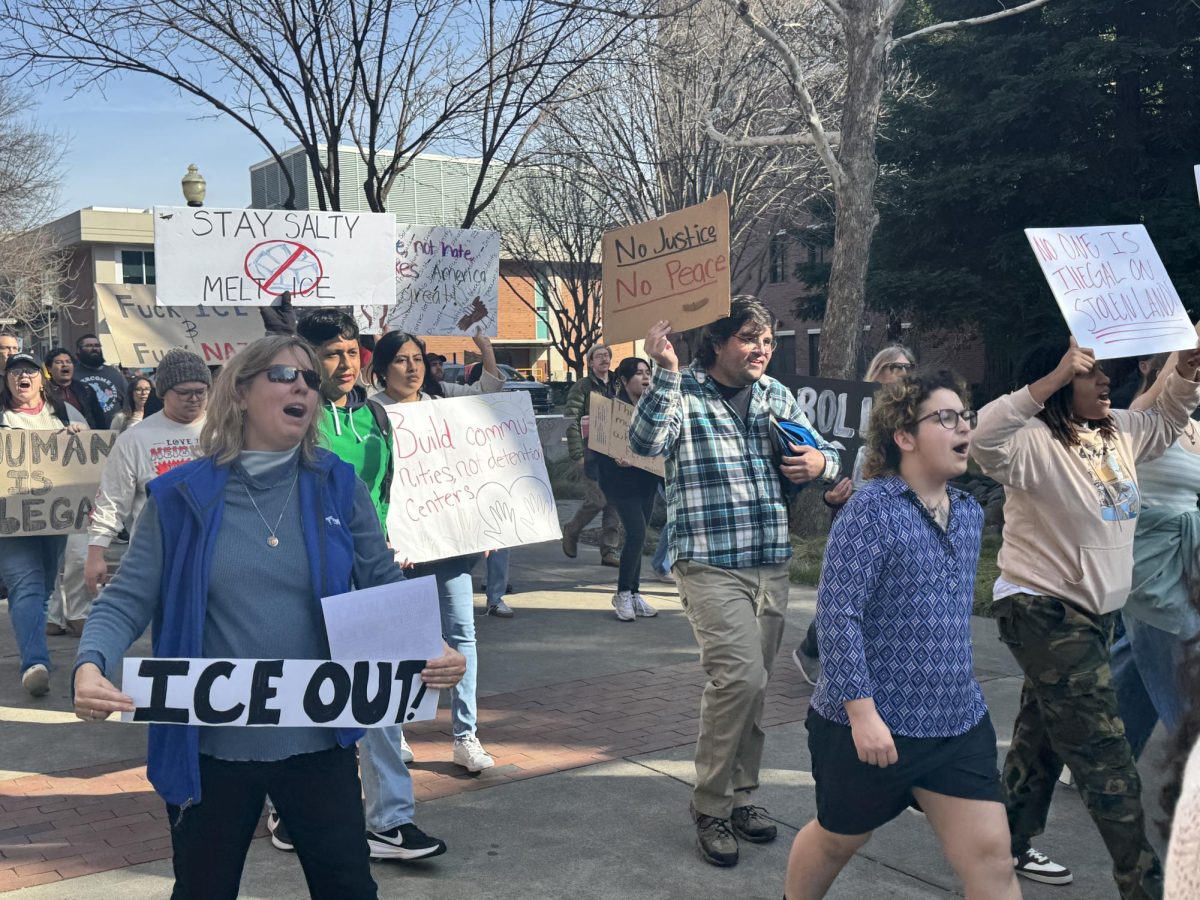
Students, faculty and staff rallied at Chico State’s campus to protest against the actions of the Immigration and Customs Enforcement agency, as part of the broader “No ICE for Good” protest nationwide. On Friday, community members expressed their opinions and thoughts in the midst of the protest.
James Carlson, a senior, said it made him feel happy to see the number of people who participated in Friday’s protest.
“It makes me feel immensely happy to see this big of a turnout. I’m astounded to see this many people here,” Carlson said. “I mean, I’m not astounded because I know that people are so angry, but it’s amazing to see it in person.”
For freshman Dmitri Bershik and Trent Fijter, who came to the protest together, they felt like they were standing up for injustices in the government.
“America really is, like, founded on immigrants, and so I think to start ruining that sanctity that we had is just truly a great injustice,” Fijter said.
Mila Jimenez, a graduate student in bilingual education and daughter of immigrants, said she felt like the way people have been treated by ICE has transcended political partisanship.
“It’s about human decency, not even just about politics anymore,” Jimenez said. “I feel like all of us being together is kind of sending a message that it’s okay to stand up for things you believe in.”
Students on Friday walked hand in hand with the faculty and staff that have supported them throughout their academic journey. This time that support moved from the classroom to marching with students against ICE.
Jennifer Harris, an admin support coordinator for the Geography and Environmental Studies Department, wanted to skip work that day, but felt conflicted about not serving students. So, on her lunch break she joined the protest.
“I feel like we’re obligated to come out and speak, and speak our mind and also speak for those who can’t,” Harris said.
Eran Zelnik, lecturer in the History Department, said he hoped that this protest inspires those at Chico State’s campus to engage in participatory democracy.
“I think that, ultimately, students are the real power on campus,” Zelnik said. “If they just get together and get inspired together. That’s the history of campus movements, and it would be beautiful to see something like that happening on campuses.”
Many students shared their fears of sliding away from a democracy — and the importance of fighting against that slide. That is something that Lenny Fernandez, a graduate student in social work, felt like he’s seeing.
“I used to be proud to be an American, and now, the truth is — I’m embarrassed,” Fernandez said. “I come from an immigrant family. It (protesting) means representing my home, my people, my family. It means … action instead of burying my head in sand.”
Fernandez said he felt like the nation is reverting to a state of Nazism, a sentiment that also comes to mind for freshman Michael Rosen.
“We’re trying to protect our neighbors and all that, and, I feel like they’re (ICE) invading it,” Rosen said. “It’s basically a whole nother Holocaust at this point.”
Unanimously, the participants of the protest shared strong opinions against ICE as they marched, chanted and waved their signs expressing their passion.
Aiden Masson can be reached at [email protected] or [email protected].

Ari Sorokin // Feb 2, 2026 at 6:56 pm
Read any serious book about the Holocaust and you’ll know this is nothing like the Holocaust. Nobody is trying to exterminate illegal immigrants. The Holocaust was a mechanized, bureaucratic mass murder, run on spreadsheets, quotas, and industrial systems of death.
Jews, people with disabilities, and Roma were not allowed to go anywhere else. They were stripped of citizenship, herded into camps, and placed in conditions explicitly designed to kill them.
Jews were citizens of these countries for generations. The people being deported today largely entered during the Biden era, in violation of existing immigration law.
The Nazis sought to create a “master race” and eliminate anyone they believed could “pollute” the gene pool. The Trump administration—however clumsy or harsh you think it is—seeks to deport people who entered the country illegally. Not immigrants. Illegal entrants. That distinction matters.
Every nation on earth has laws governing who may enter and remain within its borders. That is not racism; it is sovereignty and security.
If an administration were forcing people to wear identifying symbols, annulling marriages, stripping citizenship en masse, sending people to slave labor camps, executing them in mass graves, and documenting it all with bureaucratic precision—that would be the Holocaust.
There has been no event since that compares to the Holocaust. Nothing else reduced human beings so completely to numbers, killed them according to quotas, processed their bodies with industrial efficiency, and scavenged their remains for valuables.
What gives people the right to weaponize the suffering of real victims for contemporary political virtue-signaling—especially when they are not part of that group and lack the consensus of the people whose history they are exploiting?
And why is our education system so catastrophically bad that the word Nazi is thrown around this carelessly?
I don’t like how Trump has handled deportations—but he is not Hitler. Nobody alive today is. And hopefully no one ever will be.
If this is the level of historical literacy produced after billions of dollars in education spending, then those in charge of our education system need to do some serious self-reflection.