


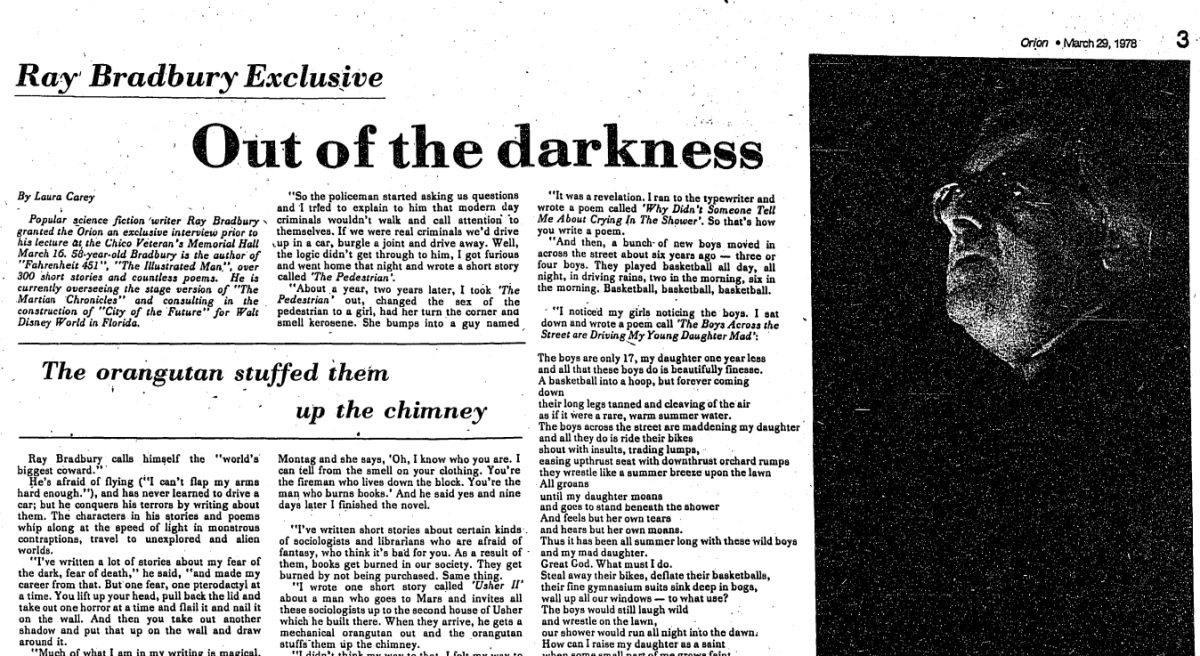
The year was 1978, and The Orion landed an exclusive interview with Ray Bradbury, one of the most well-known and influential writers of the 20th century. The genre-bending author had spent his career dancing seamlessly between fantasy, horror, mystery and science fiction.
He wrote Fahrenheit 451 and celebrated collections of short stories like The Illustrated Man and The Golden Apples of the Sun.
At the time, he was taking a break from his work on a stage production of The Martian Chronicles and was in town to give a lecture at the Chico Veterans Memorial Hall.
In the interview, he talked about the driving force behind some of his stories.
“I’ve written a lot of stories about my fear of the dark, fear of death,” he said, “and made my career from that. But one fear, one pterodactyl at a time. You lift up your head, pull back the lid and take out one horror at a time and flail it and nail it on the wall. And then you take out another shadow and put that up on the wall and draw around it.”
He also shared the story of the incident that inspired the short story that eventually became Fahrenheit 451.
“I was taking a walk with a friend one night down on Wilshire Boulevard. A police car pulled up and a policeman got out and asked me what I was doing, and I said, “Putting one foot in front of the other,” which was the wrong answer, of course. So the policeman started asking us questions, and I tried to explain to him that modern-day criminals wouldn’t walk and call attention to themselves. If we were real criminals, we’d drive up in a car, burgle a joint and drive away. Well, the logic didn’t get through to him, I got furious and went home that night and wrote a short story called The Pedestrian.”
In the March 29 issue published 80 years ago, the editors of The Wildcat made a plea to the campus community to join a newly formed press club, which they hoped would create more engagement with their paper. The Wildcat had received feedback from the campus community requesting a larger, more robust publication. The editors agreed with the community’s feedback but pushed back against some of the criticism due to the scope of what their staff could accomplish by themselves.
“…you’ll have to work for it by volunteering your services as a reporter or columnist,” according to the editorial. “If no more students show up at the Press club meetings or contact the editor, we will take it for an indication that either you are satisfied with The ’Cat as is or are unwilling to shoulder any responsibility necessary to change the paper.”
The price of gasoline was also on commuters’ minds 26 years ago. An opinion editor for The Orion, Jeff Clemetson, lamented the rising costs but maintained a fairly optimistic outlook. Gas prices had risen 17.6% between January and March of 2000, according to data from the U.S. Energy Information Administration.
Clemetson had also lived through the oil crisis in 1973, when OPEC imposed an embargo on several countries, including the United States. He questioned how our country could continue its stubborn reliance on gasoline in the aftermath of such a crisis.
But in his article, Gas price pains lead to better habits, he also suggested that people were finally “waking up to alternative transportation” and that national news was reporting a rise in carpooling and commuting by train.
In the years since, Californians in some areas have seen offerings expand, with services like Caltrain, which, despite financial challenges, has seen significant ridership growth since it began electric rail service in 2024.
“Maybe someday we’ll get to work without worrying about painting our skies a charcoal gray,” Clement said.
Archives of The Wildcat and The Orion can be found online and in the Meriam Library on campus.
