


What comes to mind when you hear “The Great Alumni Linkup”? Keeping true to its name, the 1994 event brought together Chico State alumni in more than a dozen U.S. cities via satellite in a Q&A with then-president Manuel Esteban.
Esteban was questioned by alumni about the university’s financial situation, its reputation as a party school and the status of athletics on campus, as reported by The Orion in an issue published 32 years ago today.
“While discussing his commitment to sports at Chico State, Esteban had a confession to make,” assistant news writer Rachael Christman wrote. “He said his wife Gloria had to elbow him during a basketball game against Humboldt State University because he was cheering for the wrong team.”
The one-hour program was hosted by KHSL sports anchor Royal Courtain and broadcast from the basement of Meriam Library.
Also in the news section was the police blotter, covering two days of incident reports. There were seven incidents involving drunkenness, five incidents of petty theft and two incidents of domestic violence.
When looking through the archives, letters to the editor and commentary pieces provide a consistent channel of various perspectives on controversial topics of the time, and this issue lacked neither.
An advertisement that ran in a March 16, 1994, issue of The Orion that denied the use of gas chambers during the Holocaust spurred various commentaries in the following months, including one in this issue by Peter Hoffenberg.
“Free speech does not legitimate every side as truthful or guarantee all participants the right to be treated as ‘the other side’ of a legitimate debate… Lipstadt’s book [Denying the Holocaust: The Growing Assault on Truth and Memory] is a warning. Holocaust deniers have found believers because of the current atmosphere of value-relativism in which each side carries authority, regardless of its consistency with the truth. Deniers undermine objective scholarship and historical knowledge. They rely upon distortion and not facts to fuel hatred,” Hoffenberg wrote.
The advertisement’s author, Bradley R. Smith, ran a campus campaign from 1987 to 2001 to “fuel Holocaust denial on university campuses by placing essay-length ads in more than 350 student newspapers,” according to the Anti-Defamation League. Smith was “a principal architect of Holocaust denial in America,” according to the Southern Poverty Law Center, and the founder of the Committee for Open Debate on the Holocaust.
A second mention of the Holocaust in this issue was its comparison to abortion made by a psychology and health sciences graduate student who reflected on re-watching “Schindler’s List.”
“What struck me was that the Jews were murdered because they were not seen as persons having value or purpose,” wrote Brian Kramer. “How similar is the holocaust of abortion right here in Chico! Oh, that we might mourn the brutal killings of unborn children here in our own city.”
Kramer continued drawing further comparisons, writing, “In ‘Mein Kampf’, Adolf Hitler referred to the Jews as ‘a parasite in the body of other peoples.’ On Sept. 9, 1981, on CNN, well-known feminist activist Gloria Steinem said, ‘A woman would have the right to abortion just as she has a right to remove any parasitic growth from her body.’”
Another issue of The Orion, this one published 38 years ago today, covered a lecture in Laxson Auditorium by Arkady Shevchenko, the highest-ranking Soviet official to defect to the West.
Shevchenko, who had defected to the U.S. 10 years earlier, praised cooperation between the U.S. and the Soviet Union, though he acknowledged the limits of that relationship and called the elimination of nuclear weapons an impossibility.
“The Soviet Union is a great paradox with its enormous superpower, its enormous amount of weapons… and at the same time it cannot feed itself,” he said.
As to his decision to defect, Shevchenko said, “I lost belief in Soviet policy, and I can tell you it was very hard to stand up for something I lost belief in.”
Tucked between pages 20 and 21 of the print issue was an educational pamphlet on AIDS published by the CSU Chico AIDS Coordinating Committee. Articles in the pamphlet covered topics ranging from safe sex practices to the possible benefits and risks of testing for HIV.
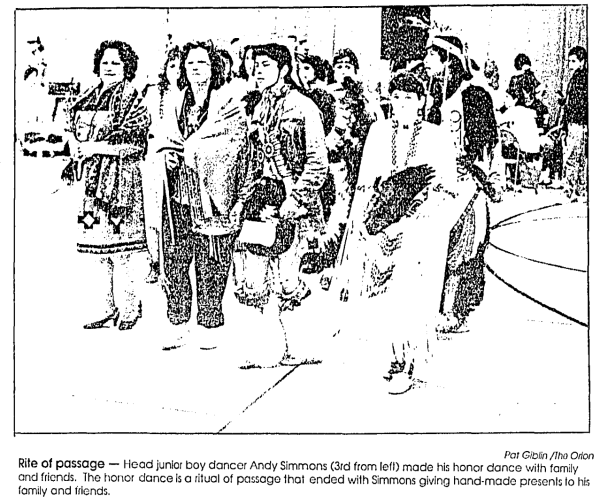
Toward the end of the issue, on the calendar of events page, it was reported that Chico State’s Tenth Annual American Indian Days was scheduled to run from April 15-16. In addition to craft vendors, the event included dancers, drums, contests and prizes.
Archives of The Wildcat and The Orion can be found online and in the Meriam Library on campus.
