

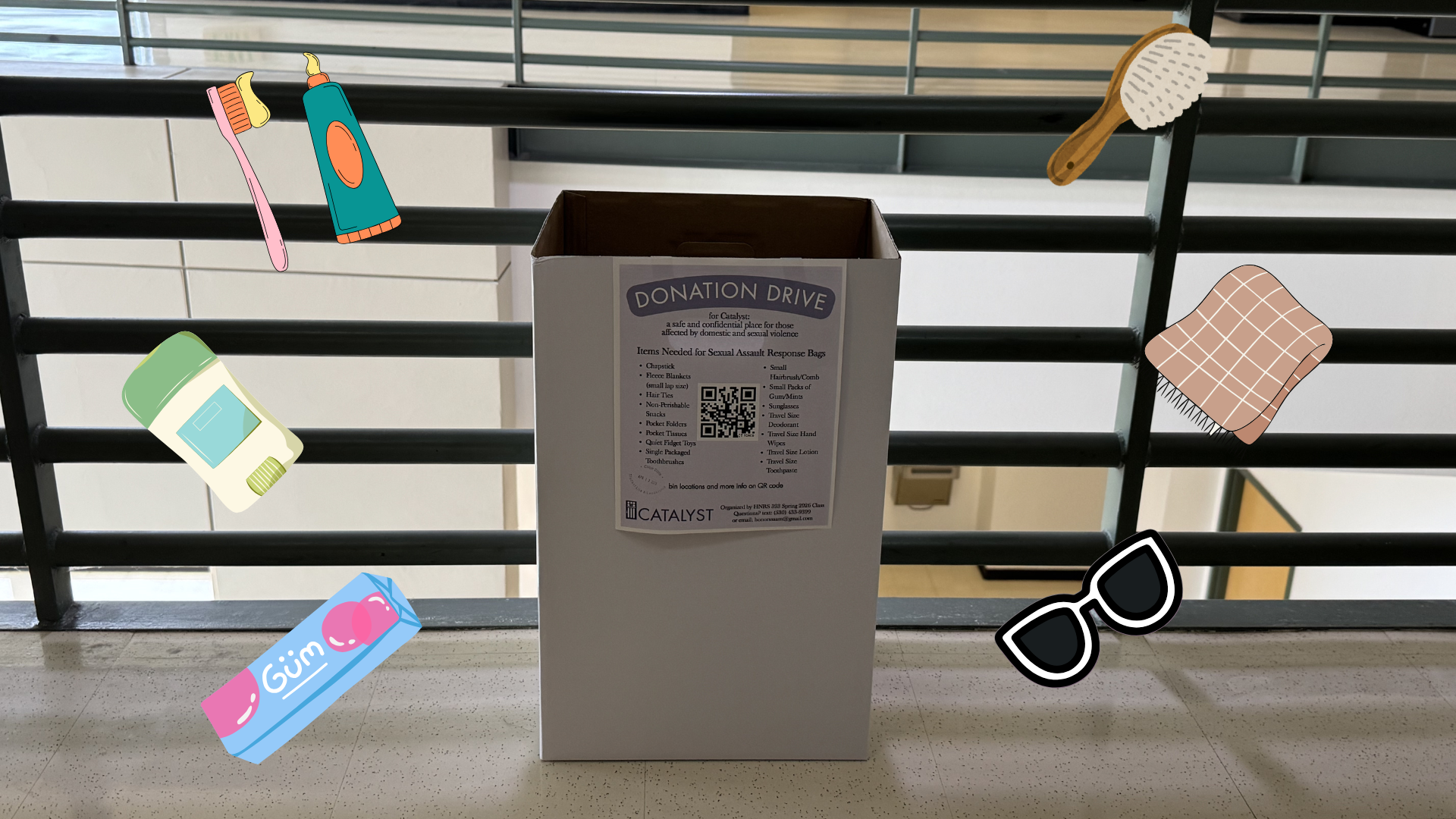

Last year, Catalyst Domestic Violence Services responded to 96 hospital calls related to sexual assault, now a Honors 393 class project is gathering donations. The aim is to spread awareness and make waiting for a sexual assault survivors more comfortable during a forensic exam..
April is Sexual Assault Awareness Month and throughout campus there will be donation bins for sexual assault response bags.
The bags “will be provided to survivors of sexual assault with items like non-perishable foods, toothpaste, throw blankets etc,” said Alana Jacobs, one of the six students working on the project.
Prevention and Outreach program manager for Catalyst, Sarah Sullivan-Aery said in an email “The sexual assault response bags are what our advocates on our 24-hour response team bring with them when they meet a survior at the hospital for a forensic exam.”
The white bins have scannable flyers with more information and can be found in various locations around campus: Yolo Hall, the Wildcat Recreation Center, Student Learning Center Room 340, Bell Memorial Union and Acker/Shurmer Gym.
Honors 393: Leadership, Power and Change is a class designed to learn about modern-day perspectives and approaches to affects of social, economic and political structures, according to the Honors program website. A component of the class includes students working collaboratively with an outside organization to create a project.
In January, Sullivan-Aery was reached out to by Molly Heck, the class’s program advisor. So, in the beginning of the semester, Sullivan-Aery presented two ideas to the class, one of which was the sexual assault response bins.
“We stuck with Catalyst because it does bring attention to the non-profit of Catalyst and it gives a safe and confidential space for those affected by domestic and sexual violence,” Jacobs said. “We would just like to bring awareness and attention to that.”
Since then, Catalyst and the project members have been working collaboratively, with the students leading the project.
“I’ve met with them a few times throughout the semester … to help guide them and answer any questions they have, but they’ve really taken the lead on all of the implementation,” Sullivan-Aery said.
Getting the word out was at times difficult, Jacobs said. Each member was in charge of reaching out to different organizations in the community. Many of the responses came from sororities, she said. The team has also been hosting presentations in clubs, such as the Neurodiversity and Disabilities club.
Residents in Oroville, where some flyers can be found, can even help out. Each flyer contains a barcode that links to an Amazon wishlist. Upon scanning the barcode and purchasing items on the wishlist, those items are sent to Catalyst to be used in the response bags.
Even if people can’t donate, Jacobs hopes when people see the flyer on the bin it’ll create interest in Catalyst’s services, especially for those who may be survivors of sexual assault.
“They will be able to say they find themselves in that situation. They will be able to know about the resources that could possibly help them,” she said.
Jacobs said donations were intended to provide comfort for those waiting on an exam, which could take hours.
“We hope to give them that support, even if it’s just the things that are in the bag,” she said.
According to Catalyst’s website, exams may involve “swabbing the mouth and any part of the body that came in contact with the person who sexually assaulted them, head and pubic hair combing/collection, photographic documentation of injuries, and a pelvic and/or rectal exam.”
These exams are crucial not only for criminal investigations, but also to inform treatment, the website stated.
Some of the items that can be donated are:
- Chapstick
- Fleece blankets
- Hair ties
- Non-perishable snacks
- Pocket tissues
- Quiet fidget toy
- Single, packaged toothbrush and toothpaste
- Hairbrush/comb
- Gum/mints
- Sunglasses
- Travel size deodorant
- Travel size hand wipes
- Travel size hand lotion
Chris Hutton can be reached at [email protected].
