


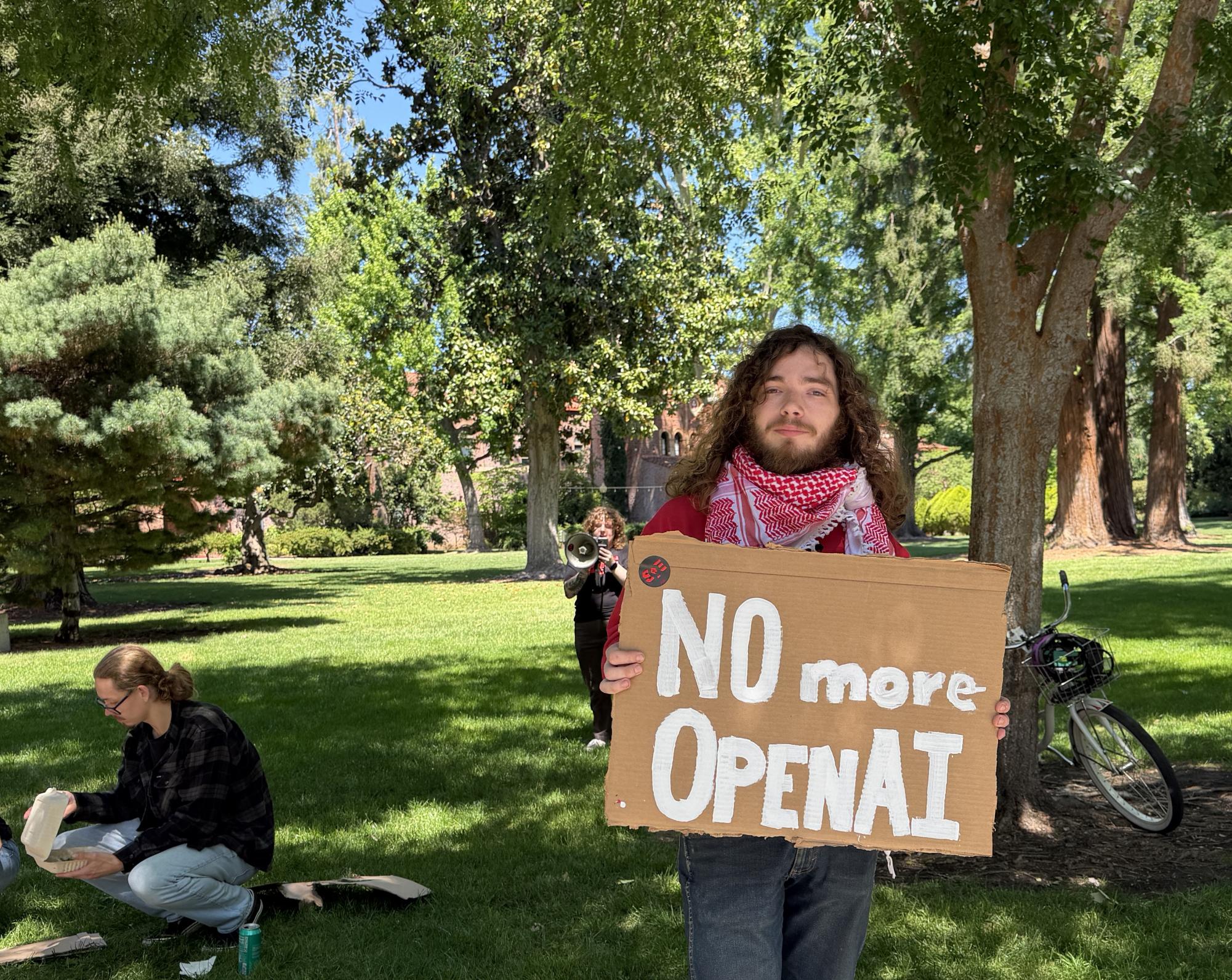
On Jan. 17, 2025, David Beaver, chief procurement officer, signed a $17 million contract with OpenAI on behalf of the trustees of the California State University without faculty consent. This made artificial intelligence software easily accessible across all 23 CSU campuses to prepare students, faculty and staff for the future of the AI-run world.
The contract will expire June 30 unless renewed; many are concerned about the impacts that will follow if it is.
The CSU purchased ChatGPT Education for 40,000 users for Term 1 of January through June 2025 and 500,000 users for Term 2 of July 2025 to June 2026. The total net amount for these terms is $16,920,000. An enticing benefit of the contract is that OpenAI will not use customer input or output to train its AI models — CSU retains all ownership rights to its input and is assigned ownership of all output generated by the services.
Alongside the contract, the CSU also created an AI Workforce Acceleration Board. This is meant to “identify and advocate for AI skills needed in California’s workforce and beyond,” according to their website. The board contains members from companies such as OpenAI, Adobe, Amazon Web Services, Anthropic, Google, IBM, Instructure, Intel, LinkedIn, Microsoft, Nvidia and Soundings. It also includes leadership from those across the CSU system, including students, faculty, and administrative representatives.
The same companies that profit from AI technology are now fist-deep in shaping how CSU students are trained to use them. The level of corporate influence is difficult to ignore.
In March 2025, the Division of IT sent out an email stating that Chico State students and employees would have access to ChatGPT Edu by April 15, 2025. This email emphasized the importance of academic integrity and freedom. It also stated that the initiative does not mandate the use of AI, but ensures that Chico State has “equitable access to the same advanced tools that are shaping industries and already being integrated at some CSU campuses.”
Included in this email is information on forums for both students and employees regarding AI. These sessions presented information on how AI is “transforming student life,” how ChatGPT is being integrated into higher education, applications of AI in education and the workforce and workshops on how to use AI “responsibly, ethically, and creatively.”
Shortly after students and employees gained access in April, ChatGPT webinars were hosted, encouraging new users to learn the different aspects of ChatGPT, its capabilities and prompting tips. Another webinar covered deep research and project creation in ChatGPT.
Many see this as a valuable resource for various reasons. Mainly, AI can help cut down the less exciting tasks, such as writing an email. Some schools have taken it a step further by integrating AI in ways that help students with disabilities. CSU Long Beach uses AI transcriptions for students with disabilities. The University of Tennessee, Knoxville, has been using an AI note-taking accommodation platform since 2022. This could prove helpful if human note-taking assistance is limited. Integrating AI into official accommodations can be useful, especially if there are not many resources available.
The real cost
In the CSU’s executive summary, it recognizes that in recent years, budget reductions have led to 1,200 positions and 1,400 courses being eliminated, as well as “reductions in student support staff, delayed hiring and facility maintenance, restructured programs, and an 8% reduction in the Chancellor’s Office budget,” according to their website.
At the same time, students across the CSU struggle to afford housing, food, tuition, and transportation. Faculty and staff struggle to keep their jobs while navigating increased workloads.
AI being so easily accessible has its benefits, but the costs are much more worrisome. Investing so much money into OpenAI instead of prioritizing students’ and faculty’s real needs is disappointing. What does this signal about the future of public higher education?
Although professors have the option to not use AI, they will inevitably deal with it. With such immediate access to ChatGPT and the unlimited information that it creates, students become more inclined to use AI in their assignments. Some professors are strongly opposed to AI and have no issue calling students in to speak with them if suspected of using it. Some, however, encourage the use through guided assignments, and may even use AI detectors such as GPTZero. Some go so far as to “create” assignments with the help of AI.
This creates a paradox: a detached system of learning and teaching where AI is a tool students are encouraged to use, but a problem instructors are trying to control.
The AI world is rapidly growing and yet the need for human intelligence is more important now than ever in our schools. Universities have long emphasized the importance of critical thinking, writing and human interaction. As AI becomes more prominent, some worry those core elements of education will be diminished.
Beyond the classroom
Unfortunately, the issues of the CSU’s partnership with OpenAI extend beyond campus.
AI is far more than a simple productivity tool. It is part of a larger network of technologies used in surveillance, policing and war. Tech companies, including OpenAI, have provided tools used in military operations. After the Oct. 7, 2023, attacks in Gaza, the Israeli military increased its reliance on commercial AI and cloud computing services from U.S. tech companies like Microsoft, OpenAI, Google, and Amazon to track and identify targets in Gaza and Lebanon, according to AP news.
AI systems are also used in law enforcement and immigration policy in the U.S. Immigration and Customs Enforcement works with Palantir Technologies to develop systems that analyze large datasets in order to identify and track individuals, according to the American Immigration Council in 2025.
Similarly, AI surveillance companies like Flock Safety are used by police departments across the country. These Flock Safety cameras can be found on CSU campuses such as Cal Poly SLO. They can also be found throughout the streets of Chico.
Although the CSU is not directly responsible for these applications, by entering into partnerships with major AI companies, it becomes part of a network that includes both innovation and surveillance, policing, and military use. This connection matters to many.
What now?
One phrase has continued to dominate the conversation: AI isn’t going anywhere.
While this may be true, it doesn’t mean that students and faculty should be excluded from the conversation and decision-making when it comes to AI.
Renewal remains uncertain, but preventative measures can be taken. The California Faculty Association has raised concerns about the impact of AI on academic labor and integrity, environmental impacts, data concerns and racism and social justice issues. CFA is sponsoring Senate Bill 928, which is meant to protect CSU employees from the growing presence of AI.
On Thursday, over ten CSU campuses protested the despicable actions this contract has encouraged.
Maya DeHoyos can be reached at [email protected].

Etta Stewart // Apr 24, 2026 at 12:14 am
Does anyone have a link to share feedback directly to the CSU contracting branches?