


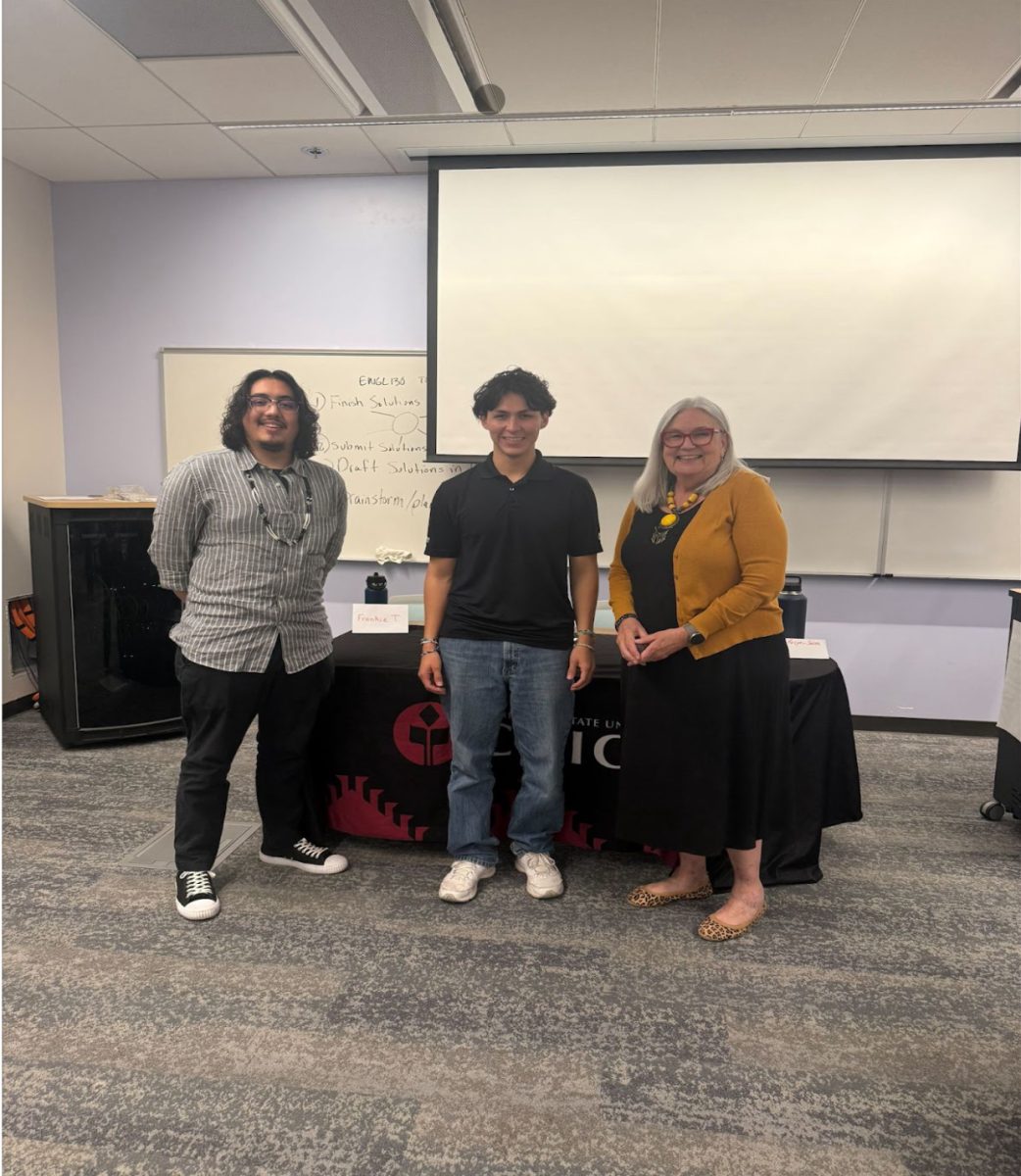
Correction: The Orion made an error. Kim Relph-Smith is not a Native and is not a member of the Berry Creek Rancheria of Maidu Indians of California.
A panel of legal professionals and a tribal relations representative brought their expertise to Chico State Thursday, offering students insight into Federal Indian Law and its real world impact. Hosted by the Chico State Pre-Law Society in collaboration with the Office of Tribal Relations, the event aimed to introduce students to the complexities of legal systems that directly affect Native communities.
Held in the Behavioral and Social Sciences building, the panel featured speakers with experience including social work, legal advocacy and cultural resource management. As a group, they provided a multidimensional look at how federal law, tribal sovereignty and cultural values intersect in both policy and practice.
Among the speakers was Kim Relph-Smith, a social worker who specializes in Indian family law and member of the Berry Creek Rancheria of Maidu Indians, one of four federally recognized tribes in Butte County and the tribe that owns Gold Country Casino. Drawing from both her professional experience and personal connection to her tribe, Ralph-Smith spoke about the importance of culturally informed legal advocacy.
Ralph-Smith has worked extensively with the Indian Child Welfare Act and gave a presentation detailing the historical and legal context behind the laws. ICWA, passed by the supreme court in 1978 aims to protect native children and keep them with their families. “Its hard to teach empathy to organizations and structures like courts,” Relph-Smith said.
Her work centers on bridging between the institutions of the courts and her connection to native communities. “I see the growth in the families and the community that I serve,” she said. “I see the ability to make better decisions for their kids.”
Ralph-Smith also pointed to the cultural misunderstandings that can arise in legal settings. “I’ve had people whose children were taken away simply because they were practicing the same parenting practice that they were taught for decades,” she said, underscoring the consequences of applying standardized legal frameworks to diverse cultural contexts.
Laretta Johnson, an attorney with California Indian Legal Services joined the panel from Zoom. Johnson discussed her experience working on cases involving Native families and emphasized both the challenges and rewards of practicing in this field.
“Its a tough line of work but it’s a really rewarding line of work when it keeps kids with their families,” Johnson said. She noted that the ICWA plays a crucial role in ensuring that Native children remain connected to their communities, traditions and cultural identities.
Johnson went on to encourage students interested in pursuing similar paths to seek out opportunities that involve direct engagement with tribal communities. Her message aligned with the broader theme of the panel: that meaningful work in Federal Indian Law requires both legal knowledge and cultural awareness.
The panel also featured Frankie Torres from Chico State’s Office of Tribal Relations, who focuses on issues related to the Native American Graves Protection and Repatriation Act and the university’s ongoing efforts to return Indigenous artifacts and remains to local tribes.
“A lot of institutions and agencies do have a lot of native American human remains and cultural items,” Torres said.“NAGPRA was passed to get these things out of agencies and institutions hands and back to the tribes and families they belong to.”
Torres highlighted Chico State’s ongoing efforts to address its own history with Indigenous collections. As of 2025, the university has repatriated approximately 95% of the cultural artifacts in its repository, marking significant progress in its commitment to tribal relations.
The event also served as an introduction for students who may not have previously encountered Federal Indian Law. According to the panelists, the goal of this was to ensure that students interested in law school leave Chico State with at least a foundational understanding of the subject.
In addition to the panel discussion, graduating members of the Pre-Law society were invited to attend and receive their graduation cords following the event, adding a celebratory element to the evening.
Throughout the discussion, panelists emphasized the importance of community involvement for students interested in advocacy or legal careers related to Native issues. Rather than focusing solely on academic preparation, they instead encouraged students to build relationships and gain firsthand experience.
“Just get involved with your local tribal communities,” Torres said, offering practical advice for those looking to make a meaningful impact.
By the end of the event, attendees were left with a clearer understanding of how Federal Indian Law operates not only in courtrooms but also in everyday life for Native families and communities. The panel underscored that effective advocacy in the field requires more than legal expertise. It demands cultural respect, historical awareness and a commitment to justice that extends beyond just the courtroom.
Merri Shiger and Caden Huntley can be reached at [email protected]

