As you head down East Ave and take the last roundabout heading east toward Wildwood Ave, you see the property lines ending and the open fields beginning. You’ve just entered Upper Bidwell Park, famous for its golf course and numerous hiking trails.
Hidden deeper down Wildwood Ave. is a small building and an even smaller parking lot. This building, with the roof wide open at night, is the Chico Community Observatory.
The Chico Community Observatory, opened in November 2001, is free for visitors who want to stargaze and learn more about our solar system. Volunteers operate the observatory’s telescopes and equipment and are available on-site during the observatory’s public hours, 8-11 p.m., Friday to Sunday. These hours are in place during daylight savings time; during Standard time, they are 6-9 p.m.
Although the observatory has specific hours when volunteers are available to answer any questions and give demonstrations, the land itself abides by Upper Bidwell Park hours. The entrance closest to the observatory is open at 7:30 a.m. and closes at 9 p.m. from October to March and closes at 11 p.m. from April to September.
The observatory recently joined the Chico Area Recreation and Park District, which allows them to publicize their information and help spread the word about events and nights that they are open.
They merged with CARD in August 2024, and they helped maintain the facilities and publicize things happening in Chico, such as the observatory and its events.
Volunteers Laurie Thiede and Dan Puser come together and share their vast knowledge and experience with astronomy and the stars with visitors.
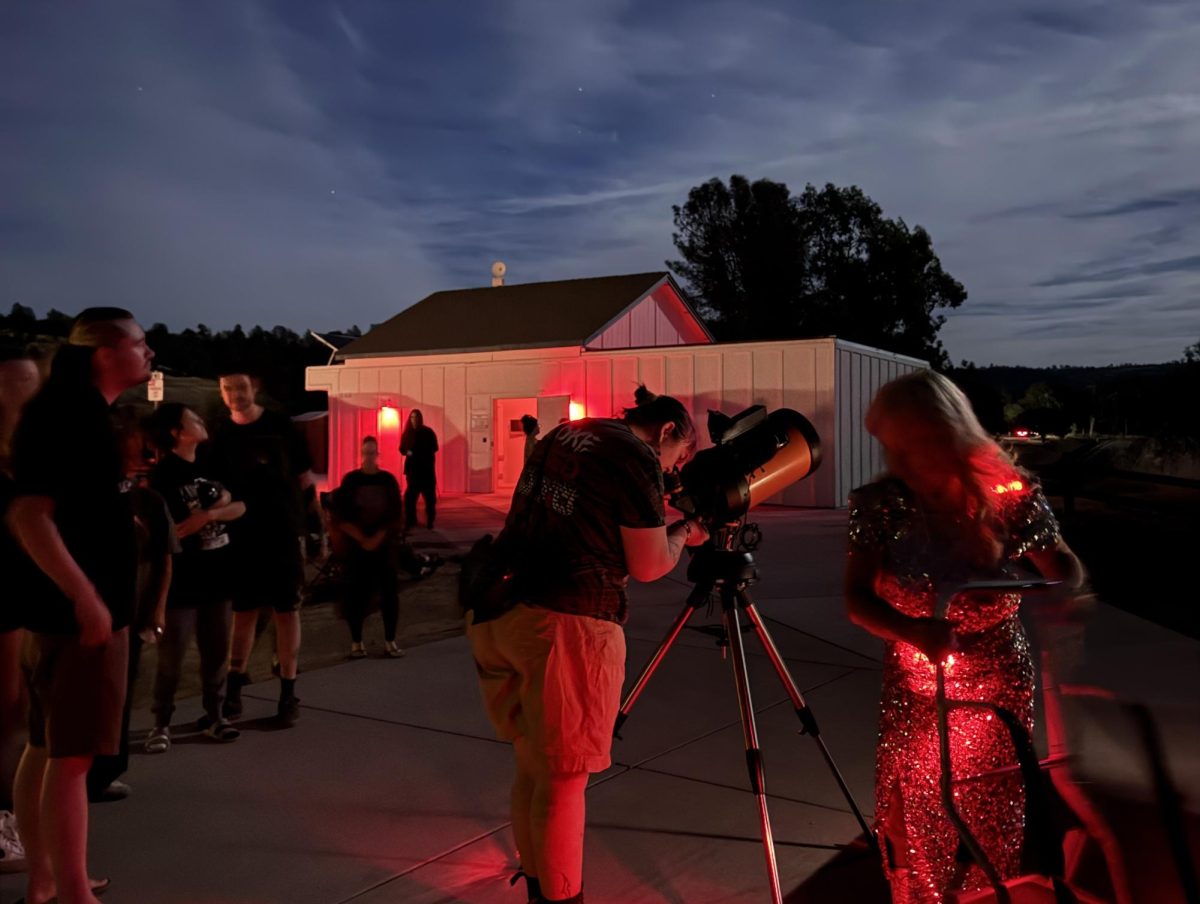
Puser is a head docent, a new title given by CARD. He’s been there for 21 years.
Puser was an avid participant before joining the observatory volunteers, constantly bringing his own personal telescope to escape the city lights.
“I got to know the sky pretty well and then I started helping out and volunteering my time as a docent,” Puser said. “I’ve been doing that ever since.”
Puser talks about his passion for astronomy and the stars, calling himself an “astronomy geek” because of his dedication to the solar system.
He describes an event he attends in the summertime with other “astronomy geeks” where they find the least light-polluted space in the northernmost corner of California and stargaze for at least a week.
“My wife made the mistake of buying me a telescope,” Puser said. “She became an astronomy widow.”
Puser earned his master’s degree in astronomy from Swinburne University in Melbourne, Australia, attending classes fully online.
He enjoys using his knowledge from his master’s and putting it toward questions visitors ask during stargazing sessions.
Puser says his favorite tool is his laser pointer, which can reach the planets and stars he is talking about in real time. Sometimes, when you’re looking through the telescope at Saturn, you can see a green laser highlighting Saturn’s rings. That’s Puser.
The observatory also uses digital telescopes, which Puser favors because they can see deep-sky objects more easily.
“We had this older [telescope] that has a camera in it, which was really cool because we could see deep sky stuff, but now we have some newer ones that have better resolution and things,” Puser said. “They can point out things like the Orion Nebula and help see it in color.”
Puser advises anyone interested in astronomy to come out to the observatory, bring your telescopes and your questions and a volunteer will be at your disposal to help.
Kids who get cheap telescopes for Christmas get frustrated because they aren’t seeing the images they see from the National Aeronautics and Space Administration’s Hubble Space Telescope. The observatory volunteers are here to help counteract the struggle and teach the next generation of astronomy geeks.
Puser described the observatory as being “completely off the grid.” They don’t have any water or bathrooms aside from a Porta-Potty provided by the City of Chico. The building itself and the equipment are solar-powered and there are panels to capture the sun’s rays on the roof.
The only energy used is to power the telescope batteries and move the roof back and forth each night they’re open. They also have televisions for the digital telescopes, and those are on for the duration of operating hours.
“For years, we were a nonprofit organization and we relied heavily on donations from the community,” Puser said. “The community has always been really good at stepping in and helping.”
Puser expressed a need for more docents and volunteers to devote their time to helping stargazers, because the current staff can only work as often as they can.
They still accept monetary donations, but their needs have lessened since merging with CARD.
Each week, the observatory’s Facebook page, managed by both Puser and Thiede, provides real-time updates on whether it will be open that night. These updates are crucial because the weather varies, especially during the rainy April and May months.
Laurie Thiede, another head docent, has been volunteering for just over two years. She generally provides information and assistance on Saturday nights and expresses her love for volunteering.
Thiede, who learned about astronomy from her father, who worked on the NASA Apollo mission to the moon in 1969, has expressed a deep passion for astronomy for her entire life.
Her father, Dr. Warren Fitzgerald, worked on the Apollo 11 rocket, titled Saturn V, and helped prepare the fireproof material needed for a safe mission. Fitzgerald even introduced her to Buzz Aldrin, an astronaut who landed on the moon in 1969.
“I grew up meeting astronauts and being very interested in space,” Thiede said.
Thiede has lived all over the world, but spent almost 20 years in New Zealand, working in the Southern Hemisphere. She was a flight attendant for Air New Zealand, eventually becoming a journalist for NASA and going on their stratosphere plane after discovering it near her home.
The plane, a flying telescope called NASA SOFIA, which is the Stratospheric Observatory for Infrared Astronomy, flew higher than commercial airplanes into the stratosphere to measure space from a different angle.
Commercial airplanes go 36,000 feet into the air, while SOFIA went 46,000 feet.
Thiede returned to the U.S. and went to the observatory as a guest first, just as Puser did, then later fell in love with volunteering and decided to give it a try.
“I’m [up here] looking at the night sky and relearning the Northern Hemisphere, because I got so used to the Southern Hemisphere’s stars,” Thiede said. “It’s a whole other set of stars.”
Thiede said she had never owned a telescope until visiting the observatory and then, just recently, was gifted her own by her grandchildren.
Thiede spent “night after night, almost 100 hours” in the backyard learning everything about her telescope, which translated to her work as a volunteer at the observatory.
“The people who work here [at the observatory] are so great, because you’ve got a really good variety of different people with different backgrounds, different ages and different personalities. They are really good at operating the telescopes, greeting people or touring the night sky,” Thiede said. “So everybody’s got our different skills.”
Since starting their Instagram and Facebook pages, Thiede has seen a vast increase in attendance and participation. Stargazers went from 25-30 to 60-70 people each night.

There is a section of the observatory called the Shoemaker Open Sky Planetarium and it’s dedicated to Gene and Carolyn Shoemaker.
The planetarium, dedicated to the two pioneers of asteroid and comet research, allows stargazers to sit back at the perfect angle and look at the night sky.
Carolyn, a Chico State graduate, married geologist Gene Shoemaker. The pair, along with astronomer David Levy, became the three astronomers who discovered the broken comet Shoemaker-Levy 9, which crashed into Jupiter in July 1994.
Gene, studying craters for the better half of his life, taught the Apollo 11 team that the ‘volcanoes’ on the moon were not volcanoes, but craters. Passing away in 1997 after a tragic car crash in Australia during a 3-day crater hunt, he was later cremated.
On January 7, 1998, the Lunar Prospector Spacecraft launched from Earth to the moon to map the moon’s surface and composition and look for polar ice. Gene’s ashes were on the spacecraft. He fulfilled a lifelong dream of going to the moon and was buried on its surface, in a crater.
Every time Carolyn would look at the moon, she’d say hello to her husband. The crater in the Moon’s South Pole was renamed “Shoemaker” in his honor, according to NASA.
Carolyn later passed away in August 2021 at the age of 92.

Thiede, teary-eyed, recalled another memory during her time at the observatory so far.
Both Puser and Thiede describe one of their favorite memories while volunteering at the observatory as the first time visitors see Saturn. The telescopes are professional and they allow you to see the seven-ring planet up close and personal.
“The very first time I saw Saturn through my telescope, [my daughter and I] were both laughing and crying,” Thiede said. “I want to remember that joy because when people first see Saturn, I think it’s gorgeous.”
Seeing planets through professional images and space technology is one thing, but seeing Saturn and other planets firsthand can be emotional and surreal.
“When [visitors] see Saturn, and the look on their face and how they exclaim, that right there is like payday for me,” Puser said.
Both Puser and Thiede recommend downloading free stargazing apps on your phone to better understand the solar system and the stars. Start with a cheaper telescope or a pair of binoculars and go to your backyard to see all there is to offer in the stars.
Elizabeth Perez can be reached at [email protected]