


Chico State’s enrollment numbers have been finalized for the fall semester, with full-time-equivalent students (FTES) and total enrollment having increased. However, the final numbers were slightly lower than the projected amount.
The university has been struggling with enrollment since the Camp Fire and the COVID-19 pandemic, however, it has been steadily trending upward since the 2022-23 academic-year. Enrollment is closely watched by the administration and the Chancellor’s Office as it reflects the health of the university and affects funding from the Chancellor’s Office and the state.
FTES, or full-time-equivalent students, is what the Chancellor’s Office and the state look at to give funding to Chico State. While headcount is important for the local community — and especially for Dining Services — when it comes to budget, the numbers that the university tends to focus on are FTES.
The university projected FTES to be at 13,828 and total enrollment to be at 14,885. However, the finalized enrollment numbers reflect slightly lower at 13,821 and 14,823.
“Our fall census numbers almost reached our goals, and we are thrilled to see increases in year-over-year enrollment for the third fall semester in a row,” said Chico State President Steve Perez.
The 2025-26 academic-year budget plan will not be affected by lower-than-projected enrollment numbers, according to Director for Financial Services Anna Magaña. Typically, falling short would mean relying more on the university’s reserves, but the difference isn’t enough to create the need to pull from the reserves this year, Magaña explained.

“We also have the potential to make up the difference with strong Spring 2026 enrollment,” Magaña said.
Associate Vice President for Enrollment Management Serge Desir attributes this lower-than-expected FTES to the lower-than-expected headcount. However, he mentioned that while it was lower, students are still taking a greater amount of units year-over-year with Fall 2024 seeing 13.76 per student compared to 13.85 this semester.
FTES numbers specific to California residents have also increased from the Fall 2024 semester by 2.8%, Magaña said. She said that the university closely watches for growth in this category, saying that the increase is a “positive trend.”
Chico State also saw a slight increase in transfer students this semester, with undergraduate transfer students jumping by about 1.64%. Undergraduate transfer students have been trending upward since Fall 2022, with the largest jump of about 40.4% from Fall 2022 to Fall 2023.
While transfer students have been on the rise, first-time freshmen have fluctuated throughout the years. This semester, first-time freshmen decreased from the Fall 2024 by about 7%. The current first-time freshman enrollment is 2,040.
Following a sharp decline in Fall 2021 and Fall 2022, continuing students who attended last semester and have returned this semester have increased steadily year-over-year. This semester, that trend has remained consistent with an approximately 4% increase from Fall 2024 to Fall 2025.
This jump is reflected in each of the three categories: continuing undergraduate, continuing postbaccalaureate and continuing graduate.
Enrollment by College
Most colleges had an increase in total enrollment from Fall 2024 to this semester, except for the College of Communication and Education and the College of Humanities and Fine Arts, both only having a slight drop in headcount.
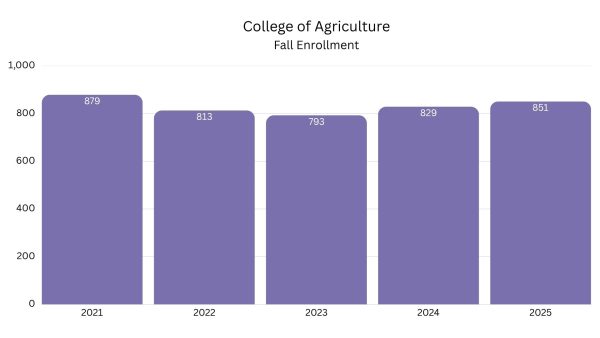
The College of Agriculture is neglected from the categorized list below because it is the only college that contains one department. The College of Agriculture saw an increase of 22 students, still short of its headcount in Fall 2021.
College of Humanities and Fine Arts
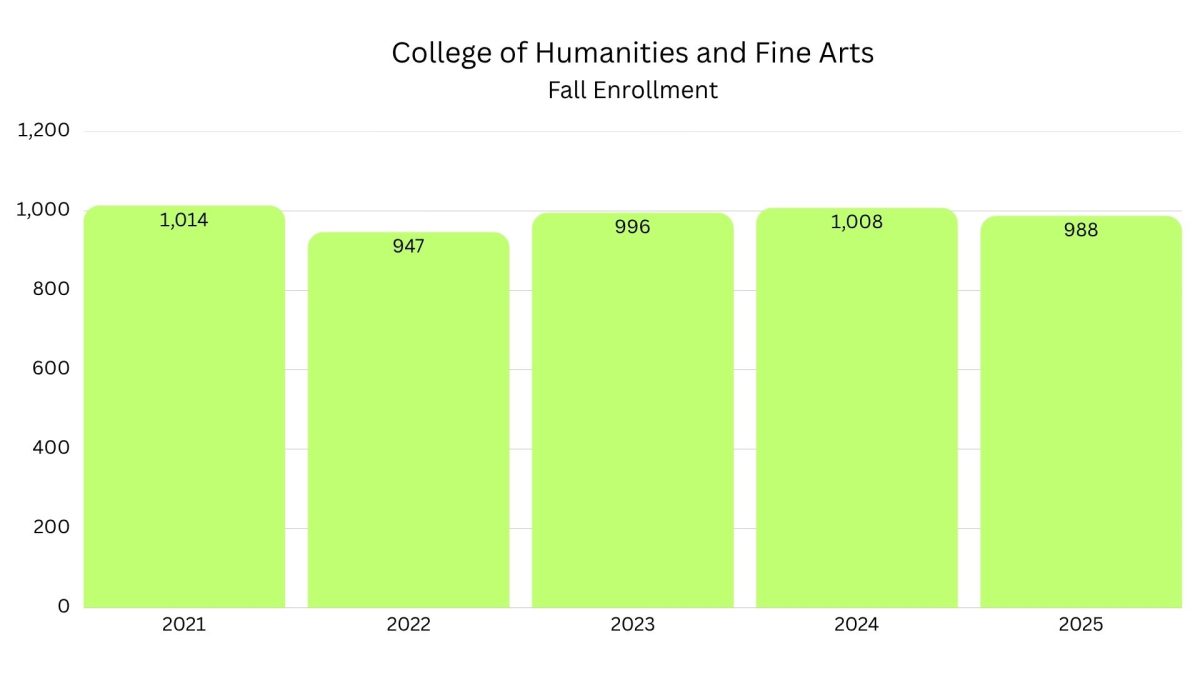
The College of HFA has been struggling with fluctuating enrollment from year-to-year. While last year saw an increase in enrollment the trend didn’t continue into the Fall 2025 semester.
Despite lower headcount in HFA, this college has a large amount of general education classes, and despite the decrease in first-time freshmen there is still plenty of students to take classes within the various programs.
The only departments in this college with an enrollment increase were Music, Theatre & Dance, and Comparative Religion & Humanities, both with an increase of 10 students.
English was the hardest hit department with 18 fewer students than in Fall 2024, with Art and Art History following close behind with 14 fewer students.
College of Communication and Education
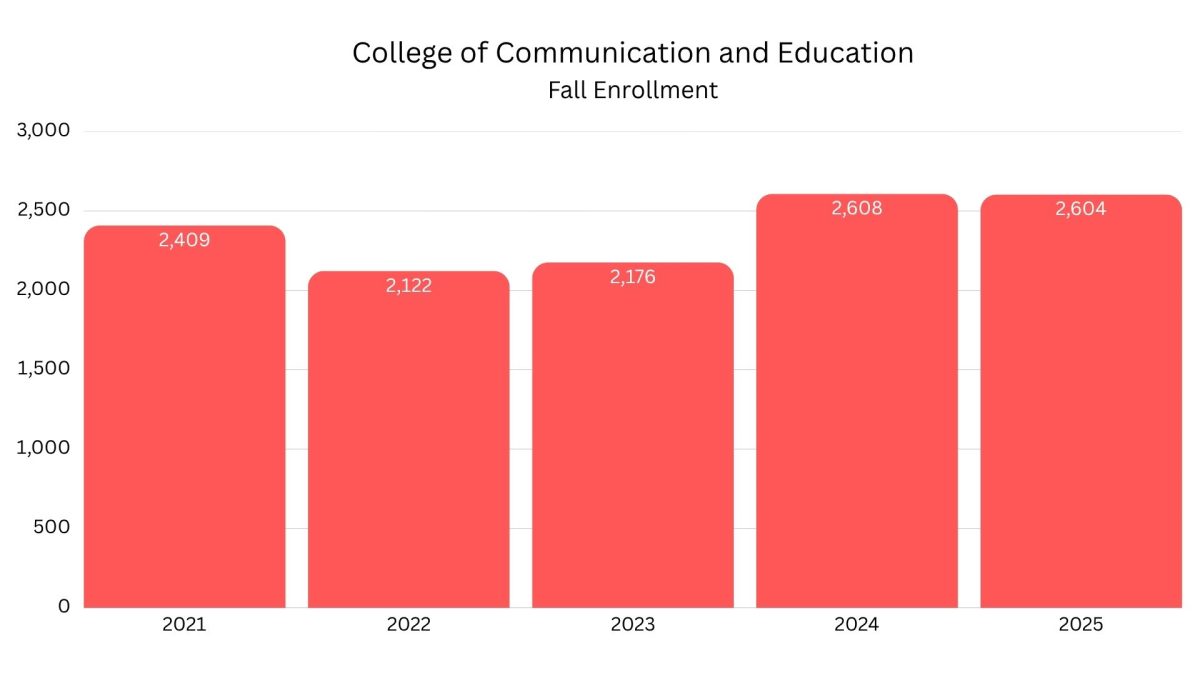
The College of CME saw a large increase, about 20%, in enrollment from Fall 2023 to Fall 2024. However, despite this large increase, Fall 2025 saw a slight decrease in enrollment from Fall 2024 — 0.15%, or just 4 students.
The department of Recreation, Hospitality & Parks has been hit hard with falling enrollment since Fall 2021. This semester, the enrollment stands at about 44% of what it was in Fall 2021. Similarly, media arts, design & technology has also seen a large decrease, this semester seeing its largest drop since Fall 2021 to Fall 2022 of 37 students.
Liberal Studies is the only department within CME that has more students than it had in Fall 2021 with a headcount of 734, an increase of 134 from Fall 2021.
College of Business
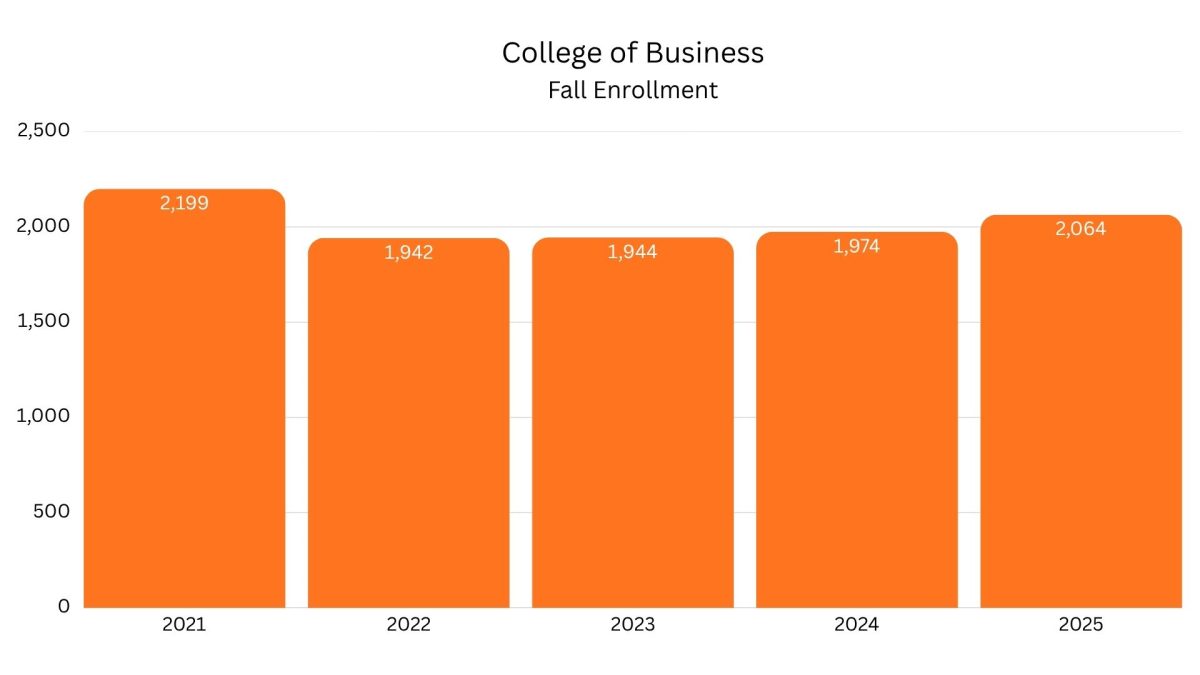
The College of Business is on an upward trajectory since its approximately 12% drop from Fall 2021 to Fall 2022. This semester the COB saw an enrollment increase of almost 5% with the new Info Systems, Finance and Accounting program bringing in 166 students.
Despite the increase for COB overall, only the department of Finance and Marketing and Accounting saw an increase in enrollment. Business Information Systems felt the largest drop in the college from 62 students — a high point from the past five years — to 21.
College of Engineering, Computer Science & Construction Management
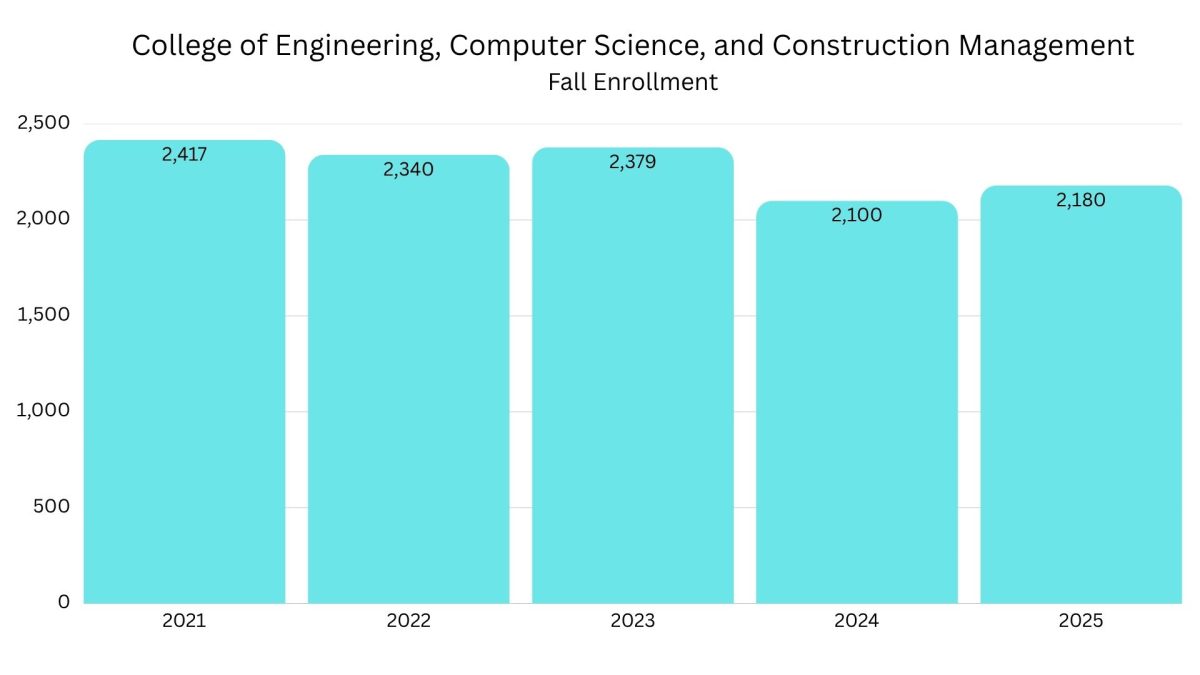
The College of Engineering, Computer Science & Construction Management has broken its five-year enrollment decline in Fall 2025 with a growth of about 3.8%.
The college’s growth is reflected in Miscellaneous Engineering, Computer Science & Technology, Electrical & Computer Engineering, Construction Management and Civil Engineering.
There was a large decline in students within Computer Science, which suffered a reduction of about 18%.
College of Behavioral and Social Sciences

The College of Behavioral and Social Sciences has almost regained its Fall 2021 enrollment numbers of 3,776 students. This follows a drop in the semester after and then a steady increase from year-to-year.
Fall 2024 to Fall 2025 saw an increase in enrollment of 2.6%, this semester’s enrollment stands at 3,717. Despite this growth, only five of the 11 departments saw an increase in headcount with none of the departments suffering from a massive reduction in enrollment.
College of Natural Sciences
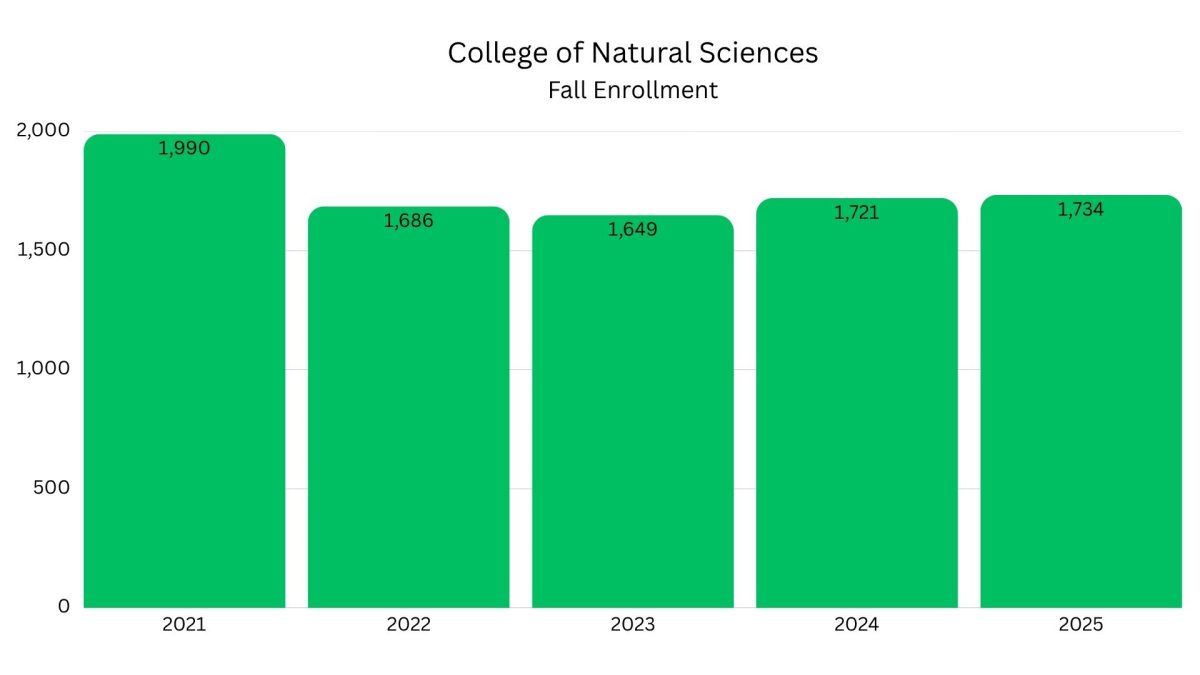
The College of Natural Sciences saw a slight increase of just 13 students from Fall 2024 to Fall 2025, but remains short by 25 students of its headcount in Fall 2021.
The largest department in this college, Nursing, saw the largest boost in enrollment of 22 students. The second largest, Biological Sciences, saw a decrease of 15 students.
Enrollment Cliff
The “enrollment cliff” — referring to a high-rate of dropoff of college-aged students — has been top-of-mind for many universities across the United States. Enrollment has been declining the past several years, with 2025 being the projected year that it takes effect. This is due to a few factors.
As an article by National Public Radio put it, “This ‘demographic cliff’ has been predicted since Americans started having fewer babies at the advent of the Great Recession around the end of 2007.”
With fewer people, there will be more graduates than incoming students.
A Pew Research Study, published in May 2024, found that one-in-four U.S. adults find that a college degree is extremely or very important to get a well-paying job. Furthermore, only 22% of respondents said that a college degree was worth it if a student had to take out loans.
With a decreasing population size and a change in culture, universities are fighting more and more over the shrinking pool of applicants.
“Given that Chico has experienced overall growth for the past couple years after multiple years of decline … it does not appear this fall was directly impacted by the Enrollment Cliff.” Serge said “… we did enroll fewer new FTICs than last year and it will become increasingly challenging to enroll that group as the population of graduating high school seniors continues shrinking for the next few years.”
“We’ll have to continue being innovative and strategic in the coming years given shrinking populations that result in more competitive markets,” Desir said. “Fortunately, we have plans in place to meet this challenge.”
With the budget crisis that the university is currently facing, enrollment — especially FTES — is a critical metric. With a lower FTES, the university would need to scrape more from the general reserves.
To combat this issue, in September 2024, the Board of Trustees for the California State University system approved a multi-year, 6% tuition increase.
Despite enrollment being lower than projected, it is still an increase from the year prior. As Desir puts it, “… this is the fifth consecutive semester (sixth, if you include summer 2025) that enrollment increased, which is worth celebrating.”
“We continue to trend upward, and it reflects the dedication and efforts of individuals across campus who have embraced enrollment as ‘Job One,’” Perez said, “Our focus remains unwavering, and we will continue to look at retention and recruitment of first-time-in-college students, transfers and graduate students as a multi-pronged strategy to attract students to the incredible educational experience at Chico State, and fulfill our promise to them.”
Chris Hutton can be reached at [email protected] or [email protected].
