


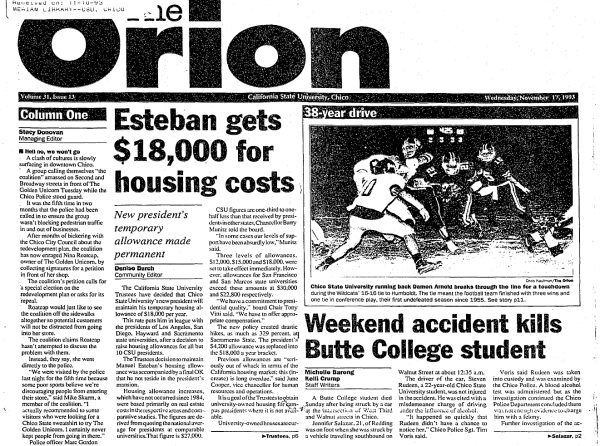
Those in the Chico State community who recall the short-lived fame of a pisser on campus this semester will be interested to know that the community in the past may have been more united in its horror and disgust of public urination than students are today. A half-page advertisement on the last page of a 1993 issue of The Orion — published 32 years ago to this day — warned people to stop urinating in public, noting that it is a misdemeanor and punishable by up to a $1,000 fine and six months in prison. The Beta Theta Pi fraternity and various local businesses signed the advertisement.
News coverage on the front page of the 24-page issue included the university’s president receiving an $18,000 housing allowance each year and the California Maritime Academy joining the CSU system. Additionally, it was reported that a Butte College student was struck and killed by a driver — a Chico State student — at the intersection of West Third Street and Walnut Street.
The housing allowance, which is the equivalent of $40,998 today, was based on real estate costs in the respective areas. In the article, the board chair stated, “We have a commitment to presidential quality. We have to offer appropriate compensation.”
Today, CSU campus presidents and the chancellor are provided with an official CSU residence where available, according to an executive benefits summary, and a housing allowance is provided if an official residence is not available. Chico State President Steve Perez resides in a house on campus, which was recommended as a condition of employment, according to an executive compensation update. Previously, the CSU Board of Trustees had approved a $50,000 annual housing allowance for the president of Chico State, but the allowance ended when Perez moved into the official presidential residence.
Revisiting the three-decades-old story of the California Maritime Academy first joining the CSU is timely, as about a year ago, the CSU Board of Trustees voted to approve the integration of California State University Maritime Academy and California Polytechnic State University, San Luis Obispo. Both times, the integrations were made due to financial challenges faced by the Academy.
Cal Maritime’s challenges today include declining enrollment and rising operations and compensation costs, according to a CSU statement. In the 1990s, the Academy was threatened with budget cuts because of large deficits the state of California was facing. By joining CSU, the Academy would share its budget, and the existing CSU system would not be affected, according to the article.
Searching further back to November 17, 1944, 81 years ago to this day, The Wildcat published a four-page issue.
Advertisements at the top of the paper called for Americans to purchase U.S. bonds and stamps to support the World War II war effort. Stamps were sold on campus two days a week, and students could volunteer to sell them. “The receipts from this week’s War Stamp sales were $26.20, a considerable increase over last week,” The Wildcat reported.
Other wartime news included a lecturer on mental hygiene in nursing visiting the campus for recruitment. “Chico State is one of 400 universities, colleges and junior colleges throughout the country being visited during the fall by the college counseling staff, in order to inform college women of wartime and post-war opportunities in nursing,” according to the article.
Two Chico State alumni were featured in the issue—a lieutenant who was placed in charge of the construction of an Army Marine railway and a staff sergeant who was awarded the Air Medal for “meritorious achievement while participating in aerial flight against the enemy.”
