


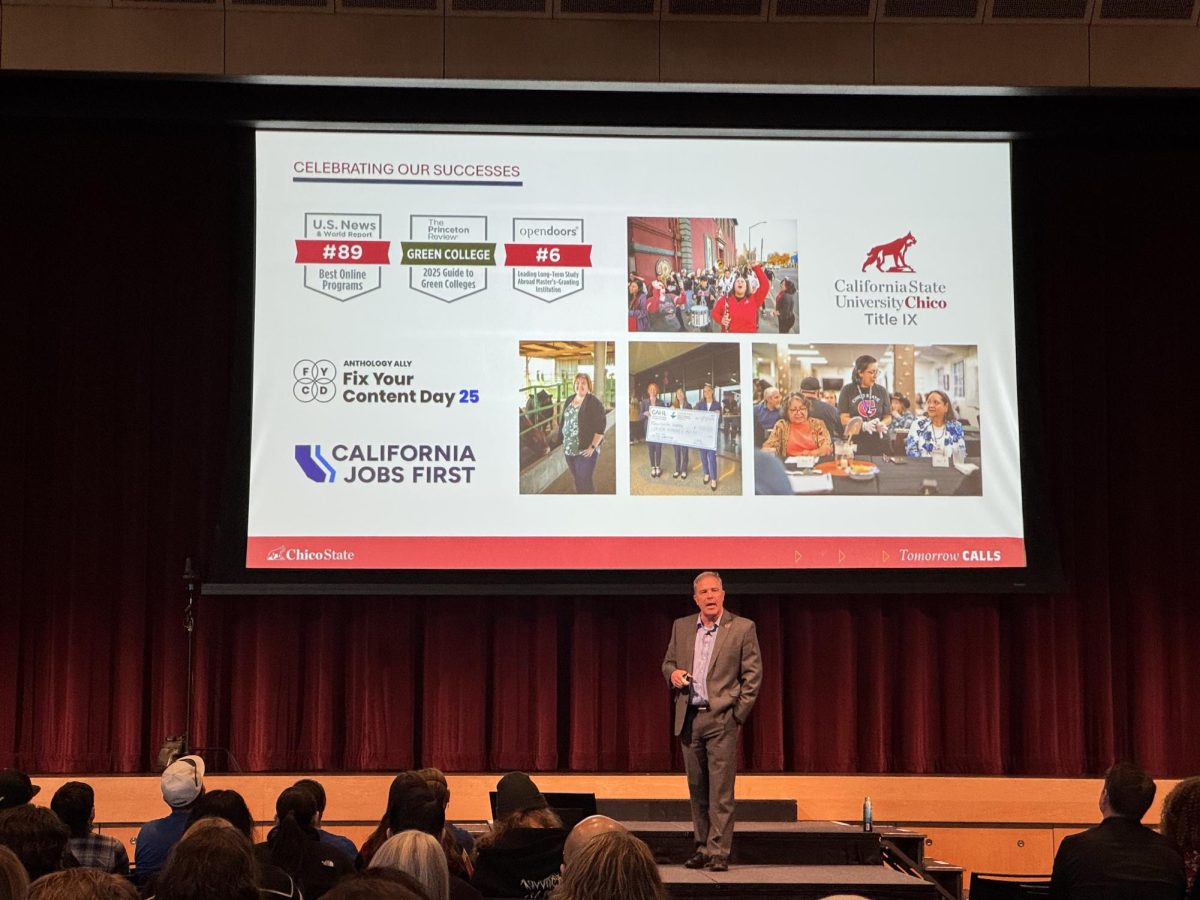
Next year, the university might crawl out of its deficit and into a surplus of just over $4 million, announced President Steve Perez during Tuesday’s State of the University address.
This news flipped the tone of last year’s address where the university projected an almost $30 million deficit for the 2026-27 academic year.
This surplus is possible because of the governor’s proposed budget, which contains increased funding for the California State University system.
“My hope was to not get cut too much, that is not what happened,” Perez said. “We actually got a proposed plan to increase spending.”
The university has also put in efforts to reduce the deficit through reductions, system-wide tuition increases and advocacy efforts alongside unions to the state legislature. These efforts have been slowly paying off, with last year estimating a deficit of $8 million but carrying forward only a $2.5 million deficit.
But these efforts from the university aren’t enough to bring about a budget surplus, and the funding increases in the governor’s proposed budget aren’t promised.
The proposed budget was released in January and will face months of criticism and revisions from the state legislature until its finalized in June. This is why the university and the California State University Employee Union intend to continue its advocacy efforts, said Vivian Mendoza, CSUEU labor representative.
The projected surplus is also being aided by the 2022 compact agreement between the governor’s office and the CSU system.
The compact agreement, signed in 2022, provided universities in the CSU with a 5% increase in funding each year for five years. However, funding for year four of the agreement was deferred to the 2028-29 academic year. The governor’s office intends to honor the compact agreement for year five.
The university will receive $11.3 million from the compact agreement for year five and the partial payment from year four.
The university will still face a deficit of just over $3 million this academic year. Perez said the university intends to cover the deficit from its reserves, which holds $46 million in its unrestricted reserves.
It isn’t just outside funding that Perez shared positive news on. Enrollment continues to trend upward, with the university projecting 13,831 full-time-equivalent students (FTES) and a headcount of 15,632.
This would be an almost 2% increase in FTES and about 1.7% increase in headcount from the last academic year. But while numbers are still trending upward, the percentage falls short of the growth the university saw last year — about 7% for FTES and about 12% for headcount.
FTES is what the university reports to the CSU and the governor’s office, it’s calculated by the total amount of credits that all students are taking divided by 15.
The university is also asking for participation in a survey for the Western Association of Schools and Colleges (WASC), which seeks input from campus community members about what is and isn’t working across campus.
Chico State is up for WASC accreditation in 2027, with the last accreditation grant occurring in July 2019. Accreditation is critical for numerous reasons, for example, the university can only participate in the financial aid system if it’s accredited.
“I have no doubt we will come through with flying colors,” Perez said.
Perez also announced the return of the Employee Climate Survey Committee, which was formed in 2021 following recommendations from the Academic Senate to then-President Gayle Hutchinson. The committee conducts both qualitative and quantitative surveys of faculty, staff and administrators to track the overall feelings toward the university, according to the website.
The last Employee Climate Survey was released in October 2023. The executive memorandum, EM-21017, outlines that the survey be performed “at least once every three years.” Before 2023, the university didn’t have a survey until 2018, a five-year gap.
In 2024, the university switched from the Employee Climate Survey to the Great College to Work For survey, administered by ModernThink. Several goals for how to create a better workplace came from the data collected in the survey. Perez said that the university had made a committed effort to accomplish them. A new survey is set for Spring 2027, with the questions partially being chosen by the Employee Climate Survey Committee.
Throughout the address Perez hailed the community efforts and initiatives that have been implemented, such as Wildcat Wednesday, its presence in downtown Chico and the College Corps.
“I’ve said it in any number of places, this is the greatest university in the world,” Perez said to conclude the address. “I think I showed you that we’re the greatest university in the United States. I would argue, passionately, that we work with the best students and the best colleagues.”
Chris Hutton can be reached at [email protected] or [email protected]
